Roofing Quote & Estimate Template
By QuotApp Team · Updated October 17, 2026
A roofing quote template is a pre-formatted document that prices a roof by the square — tear-off, decking, underlayment, flashing, ventilation, shingles or panels, permit and cleanup — so a homeowner can compare your number to the other bids line by line. Download the free Word template below (quote and estimate versions), copy the filled-out replacement example, or build it online with the free quote generator. For larger jobs, the roofing proposal template wraps the same price in inspection findings and warranty terms.
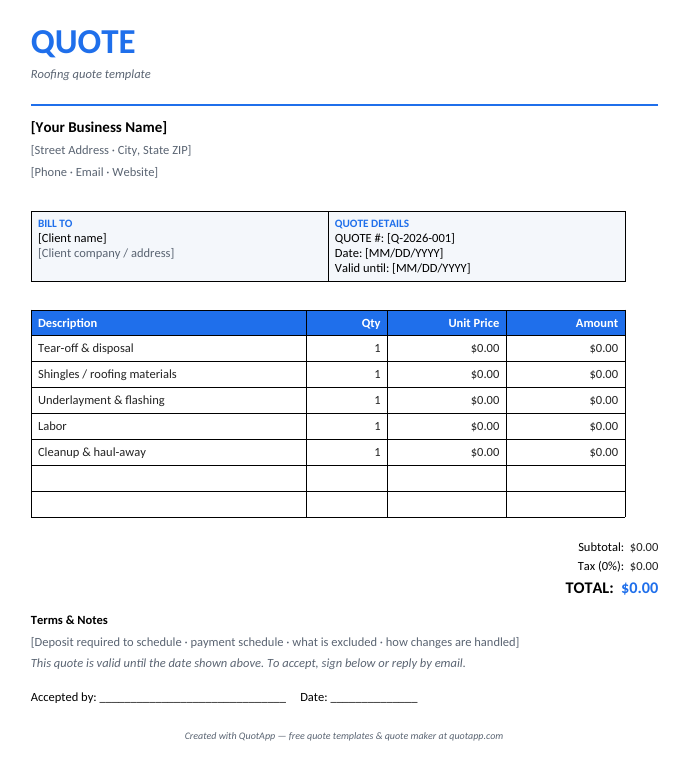
⬇ Free download — no sign-up
- Roofing Quote Template (Word) — Pre-filled with industry line items
- Quote Template (Excel, auto-calculating)
- Quote Template (PDF)
- Roofing Estimate Template (Word) — Estimate wording with a contingency line
- Roofing Proposal Template (Word) — Findings, scope, warranty, acceptance
Create this quote online — free Browse all templates
Which roofing quote template do you need?
| Variant | Use it when | What changes in the template |
|---|---|---|
| Asphalt shingle replacement | Most residential re-roofs. | Priced per square with waste factor; tear-off layers; decking allowance; ice-and-water shield zones; ridge vent; manufacturer warranty registration. |
| Metal roof | Standing seam or exposed-fastener panels, re-roof or over existing. | Priced per square by panel type and gauge; trim and flashing package; underlayment rated for metal; longer lead times; snow guards where needed. |
| Repair quote | Leaks, storm damage, flashing or vent failures. | Findings with photos; task list; minimum charge; matching-materials disclaimer; short warranty. |
| Insurance claim estimate | Storm or hail damage with an adjuster's scope. | Line items aligned to the adjuster's scope; supplements listed separately; deductible noted; documentation and photo appendix. |
Filled-out roofing quote example
This is what the template looks like completed for a real job — tear-off and replacement of a 6/12-pitch gable roof, 2,340 sq ft measured (26 squares with waste), architectural asphalt shingles. Prices are illustrative US figures; swap in your own rates.
Prepared for Paul & Renee Sutton, 224 Hillside Ave
| Description | Qty | Unit | Unit price | Amount |
|---|---|---|---|---|
| Tear-off one layer, disposal and dump fees | 26 | square | $105.00 | $2,730.00 |
| Architectural shingle system installed — underlayment, ice & water, drip edge, starter, ridge cap | 26 | square | $360.00 | $9,360.00 |
| Ridge vent | 38 | lin ft | $9.50 | $361.00 |
| Pipe boots (4) and step flashing at chimney and sidewalls | 1 | lot | $480.00 | $480.00 |
| Decking replacement ALLOWANCE — 7/16 in. OSB | 5 | sheet | $95.00 | $475.00 |
| Building permit and final inspection | 1 | permit | $280.00 | $280.00 |
| Magnet sweep, landscaping protection, cleanup | 1 | lot | $250.00 | $250.00 |
Includes one-layer tear-off and disposal, synthetic underlayment, ice-and-water shield at eaves and valleys, new drip edge, starter, pipe boots and step flashing, ridge vent, architectural shingles with manufacturer's limited warranty (registered on completion), permit, magnet sweep and cleanup. Decking: 5 sheets included; additional sheets $95 each, photographed and approved before replacement. Workmanship warranty 10 years. Excludes chimney rebuild, gutters and skylights. 30% deposit, balance on completion. Quote valid 21 days.
Rebuild this example in the free quote generator and export it as a PDF in under a minute.
Typical roofing prices in the US
Use these ranges to sanity-check your line items, not to set them — your labor rate, market and overhead decide the final number.
| Item | Typical range | Notes |
|---|---|---|
| Typical roof replacement | $5,700 – $16,000 | 2,000 sq ft home: $6,700 – $13,400 |
| Asphalt shingles installed | $3 – $6 per sq ft | |
| Metal roofing installed | $5 – $16 per sq ft | |
| Tile roofing installed | $7 – $25 per sq ft | Slate/stone $10 – $30 |
| Installation labor | $150 – $300 per square | 1 square = 100 sq ft |
| Tear-off | $1 – $5 per sq ft | Heavier materials cost more to remove |
| Architectural shingles (material) | $100 – $250 per square | 3-tab $80 – $130 |
| Roofing permit | $100 – $500 |
Source: HomeGuide — Roof Replacement Cost, updated November 7, 2025. Ranges are national; adjust for your region.
How to price a roofing job, step by step
Roofing is priced per square, but the square price is an average of very different costs: tear-off weight, roof pitch, cut-up complexity, decking condition and the material system. The process behind the example above:
- Measure accurately and add waste. Sum each roof plane, divide by 100 for squares, add 10% waste for simple roofs and 15%+ for complex ones. Note pitch — steep roofs (8/12 and up) need staging and slow production; many roofers add a steep charge per square.
- Inspect what you are going to tear off. Count layers, check decking from the attic for delamination, rot and sag, and photograph flashing, boots and vents. These findings justify the price and become page two of a proposal.
- Price tear-off per square by layer and material. One layer of asphalt is the baseline; a second layer, wood shakes or tile cost more in labor and disposal.
- Price the roofing system per square. Materials at cost plus markup (underlayment, ice-and-water shield, drip edge, starter, field shingles, ridge cap, nails) plus crew labor per square from your production records. Use the markup calculator to hit your margin on materials and the labor cost calculator for crew cost.
- Add flashing, boots, ventilation and accessories as separate lines — they are where cheaper bids cut corners and where your quote can show its quality.
- Write the decking rule. Sheets included, price per sheet beyond, photo approval.
- Add permit, dumpster or haul-off, magnet sweep and landscaping protection.
- Compare to the market range and your margin. Asphalt re-roofs in most US markets fall around $3–$6 per square foot installed; if yours is far outside, find out why before sending.
What to include in a roofing quote
- Header with license, insurance, and manufacturer certifications if you hold them.
- Client, property address, roof type and pitch, measurement source.
- Quote number, date, validity.
- Findings summary (a few lines) or a reference to the attached photos.
- Line items: tear-off, roofing system per square, ventilation, flashing and boots, decking allowance, permit, cleanup.
- Material specification: brand, line, color, warranty.
- Warranties: manufacturer material warranty and your workmanship warranty, stated separately.
- Exclusions: chimney rebuild, gutters, skylights, structural framing, interior repairs.
- Weather clause and schedule.
- Payment terms and signature lines.
Replacement, metal, repair and insurance quotes
Asphalt replacements are compared side by side, usually against two other roofers. Make yours easy to compare: same order every time, the system spelled out layer by layer, both warranties stated.
Metal roofs are priced per square by panel profile and gauge, with a trim and flashing package that is often 20–30% of the material cost. Lead times are longer; put the material order date in the schedule.
Repairs need a findings line (“cracked pipe boot at the bathroom vent stack causing ceiling stain”) and a task list. State a minimum charge and that new shingles may not match weathered ones exactly.
Insurance work follows the adjuster’s scope. Align your line items to theirs, list supplements separately with photos, note the deductible, and keep the homeowner informed of what the carrier has approved. Avoid any language that offers to cover or waive the deductible — many states prohibit it.
For jobs where you are competing on more than price, present the quote inside the roofing proposal template: findings with photos, scope by layer, materials and warranty, then the price.
Common mistakes that cost roofers money
- Measuring from the footprint without a pitch factor. A 6/12 roof is about 12% larger than its footprint; a 12/12 is about 41% larger.
- No decking rule. Every replaced sheet becomes a negotiation.
- Flashing “as needed”. Spell it out; it is what separates your quote from the cheapest bid.
- Forgetting disposal weight. Two layers or heavy materials can double dump fees.
- Warranty as a slogan. “Lifetime warranty” without terms helps nobody and exposes you.
- No weather clause. Rain delays should not look like your fault.
Quote or estimate for roofing?
Send a quote after measuring and inspecting the roof. Send an estimate when pricing from aerial reports or photos, for storm work before the adjuster’s visit, or when decking condition is unknown — give the price per square, the assumptions and what confirms the final number. Both versions are downloadable above; the difference is explained in quote vs estimate.
Sending the quote and following up
Send the PDF the same day as the inspection, with the total, the material, both warranties and the earliest install window in the email body. Homeowners usually decide within a week of the last bid arriving; follow up on day 2 with the photos and on day 7 with an answer to the most likely question (decking, warranty, or timing). The follow-up guide has templates. Once accepted, a change order covers any decking beyond the allowance.
Frequently asked questions
What should a roofing quote include?
Your license and insurance, the client and property address, quote number and date, measurements in squares with the waste factor, line items for tear-off, decking, underlayment, flashing, ventilation, roofing material by brand and line, permit and cleanup, the decking rule, both warranties (manufacturer and workmanship), exclusions, payment terms, validity and a signature line.
How do I calculate roofing squares?
Measure each roof plane's area (from the roof, from aerial measurement reports, or from the footprint × a pitch factor), add them, divide by 100 and add a waste factor — about 10% for simple gables and 15% or more for hips, valleys and dormers. The example uses 2,340 sq ft measured plus waste, rounded to 26 squares.
How should I quote decking replacement?
As an allowance: a number of sheets included in the price, a per-sheet price beyond that, and a sentence that you will photograph and get approval before replacing more. Decking is the most common roofing change order; a written rule removes the argument.
Should I list the shingle brand?
Yes — brand, product line, color (or 'to be selected'), and warranty term with any registration requirement. Homeowners compare bids on materials as much as price, and a named product protects you from disputes about grade.
How long should a roofing quote be valid?
14 – 30 days. Material prices change and storm seasons fill calendars; print the validity date and re-confirm prices if accepted later.
Quote or estimate for roofing?
Quote when you have measured the roof and inspected it. Estimate from aerial measurements or photos before a site visit, or when decking condition is unknown — and say what will confirm the price. Both versions are available above.
Related tools and templates
- Roofing proposal template — findings, warranty, acceptance
- Construction quote & estimate template
- Free quote generator — build this quote online
- Markup calculator — price materials with your margin
- How to follow up on a quote
More quote templates
Skip the template. Build it online.
The free QuotApp quote maker fills in the math, formats everything professionally, and gives you a ready-to-send PDF in under a minute.
Create a free quote now