Painting Quote Template
By QuotApp Team · Updated September 27, 2026
A painting quote template is a pre-formatted document that breaks a paint job into surface prep, paint and materials, labor and extras, so the client sees exactly what the price covers. Download the free template below (Word, Excel or PDF), copy the filled-out example, or build the quote online with the free quote generator. The same layout works as a painting estimate when the scope is not final yet.
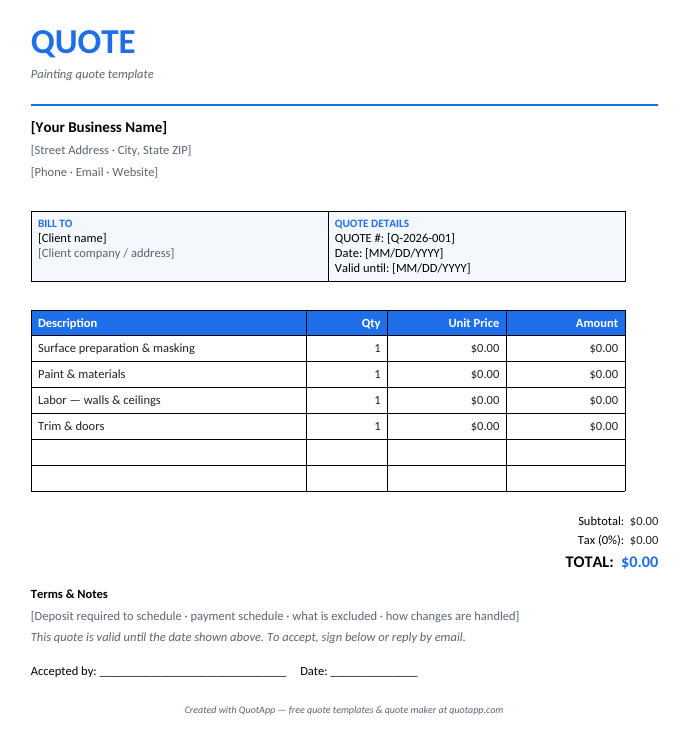
⬇ Free download — no sign-up
- Painting Quote Template (Word) — Pre-filled with industry line items
- Quote Template (Excel, auto-calculating)
- Quote Template (PDF)
- Painting Estimate Template (Word) — Same layout, estimate wording and contingency line
Create this quote online — free Browse all templates
Which painting quote template do you need?
| Variant | Use it when | What changes in the template |
|---|---|---|
| Interior repaint | Walls, ceilings and trim inside an occupied home or office. | Price per room or per square foot of wall; separate line for ceilings and trim; furniture moving and floor protection as their own items. |
| Exterior repaint | Siding, trim, doors, decks and fences. | Pressure washing, scraping and caulking as prep lines; primer where bare wood shows; ladder or lift rental; weather clause in the terms. |
| Commercial / new construction | Offices, retail, multi-unit or builder work priced by the drawing. | Price per square foot by finish schedule; after-hours labor rate; number of coats and product specified per surface; retainage and progress billing terms. |
| Cabinet or specialty finish | Kitchen cabinets, doors, staircases, faux or lacquer finishes. | Count of doors and drawer fronts instead of square feet; degrease, sand and prime steps listed; spray finish and cure time noted; higher hourly rate. |
Filled-out painting quote example
This is what the template looks like completed for a real job — interior repaint of a 3-bedroom house (walls and ceilings, 1,650 sq ft of wall area). Prices are illustrative US figures; swap in your own rates.
Prepared for Maria Ortiz, 214 Willow Lane
| Description | Qty | Unit | Unit price | Amount |
|---|---|---|---|---|
| Surface prep: patch nail holes, sand, caulk gaps, spot-prime repairs | 1650 | sq ft | $0.35 | $577.50 |
| Walls — two coats premium interior eggshell | 1650 | sq ft | $1.60 | $2,640.00 |
| Ceilings — one coat flat ceiling white (4 rooms + hallway) | 780 | sq ft | $1.10 | $858.00 |
| Trim, doors and baseboards — two coats semi-gloss | 310 | lin ft | $2.75 | $852.50 |
| Paint and materials (12 gal wall, 4 gal ceiling, 2 gal trim, sundries) | 1 | lot | $640.00 | $640.00 |
| Furniture moving, floor and fixture protection, daily cleanup | 1 | lot | $220.00 | $220.00 |
Price includes two coats of Sherwin-Williams Duration on walls and one coat of flat ceiling white. Client to remove wall hangings and small items; we move and cover furniture. 50% deposit to schedule, balance on completion. Quote valid 30 days.
Rebuild this example in the free quote generator and export it as a PDF in under a minute.
Typical painting prices in the US
Use these ranges to sanity-check your line items, not to set them — your labor rate, market and overhead decide the final number.
| Item | Typical range | Notes |
|---|---|---|
| Painter labor rate | $25 – $75 per hour | $100+ for specialty finishes |
| Interior painting (labor + paint) | $1 – $3 per sq ft | Walls only; add ceilings and trim separately |
| Exterior painting | $1 – $4 per sq ft | Prep-heavy jobs sit at the top of the range |
| Commercial painting | $2 – $6 per sq ft | After-hours work and lifts push it higher |
| Per room (walls only) | $300 – $1,000 | $600 – $2,000 with ceilings and trim |
| Day rate (one painter) | $200 – $600 | Covers roughly 150 – 350 sq ft per hour |
| Paint | $20 – $80 per gallon | One gallon ≈ 400 sq ft, one coat; 5-gal buckets $75 – $300 |
| Target profit margin | 20% – 40% | Well-run shops net 13% – 27% after overhead |
Source: HomeGuide — How Much to Charge for Painting, updated December 17, 2025. Ranges are national; adjust for your region.
How to price a painting job, step by step
Painting is priced on two numbers: how many square feet you will cover and how long the prep will take. Everything else is markup and margin. This is the process behind the example above.
- Measure the surfaces, not the room. Wall area = perimeter × wall height, minus doors and windows over 15 sq ft. Ceilings = length × width. Trim = linear feet of baseboard, casing and crown. Write the measurements on the quote; a client who can check your math rarely argues about the rate.
- Grade the prep. Walk the job and score each surface: light (fill nail holes, sand, spot prime), medium (patch cracks, caulk, sand glossy trim), heavy (peeling paint, water stains, wallpaper removal, drywall repair). Light prep adds 10–15% to labor; heavy prep can double it. Put prep on its own line so the client sees why a “simple repaint” costs what it does.
- Set your production rate. A working painter rolls 150–350 sq ft of wall per hour after prep, cuts in about 60–100 linear feet of trim per hour, and sprays far faster. Use your own numbers from the last ten jobs; the ranges above are only a sanity check.
- Price labor from your loaded hourly cost. Take wages, payroll taxes, insurance, vehicle, tools and the hours you cannot bill, and divide by billable hours. Most US painting companies land at $45–$75 per billable hour of cost before profit. The labor cost calculator does the arithmetic.
- Add paint and materials with a markup. Count gallons (wall area ÷ 400 sq ft per gallon per coat, rounded up per color), add primer, caulk, tape, plastic, sandpaper and sundries, then apply your markup — 15–30% is common. The markup calculator converts the margin you want into the markup you need.
- Add the job-level items. Furniture moving and protection, ladder or lift rental, disposal, travel beyond your radius, after-hours work. These are the lines painters forget and then absorb.
- Check the total against the market range and your margin. If the number is far under the ranges in the table above, you have missed prep or overhead. If it is far above, decide whether you can justify it in the scope wording or need a cheaper paint option.
What to include in a painting quote
The template is laid out in this order because it is the order a homeowner reads it:
- Header: business name, license and insurance numbers, phone, email, address. Painting is a trust purchase; the license number does more work than your logo.
- Client and job address. If the billing address differs from the job site, show both.
- Quote number, date and validity. Sequential numbers (Q-2026-014) make follow-ups and invoices easy to reference.
- Scope statement. One paragraph: which rooms or elevations, which surfaces, how many coats, product line and sheen, color count. “Two coats Sherwin-Williams Duration eggshell, walls only, up to three colors” is a scope. “Paint living room” is a dispute waiting to happen.
- Line items for prep, walls, ceilings, trim, materials and job-level extras, each with quantity, unit and unit price.
- Options. Priced separately below the total: accent wall, closet interiors, premium paint upgrade, ceiling in the hallway. Options raise the average ticket without inflating the headline price.
- Exclusions. Wallpaper removal, drywall repair beyond patching, lead-paint abatement (pre-1978 homes), moving pianos and electronics, color consultation.
- Terms. Deposit, payment schedule, how change orders are priced, weather clause for exterior work, touch-up and warranty policy.
- Acceptance line. Signature, printed name and date. A quote the client can sign converts better than one they have to reply to.
Interior vs exterior painting quotes
Interior quotes are about protection and disruption: who moves what, how many rooms are out of use at once, low-VOC product for occupied homes, daily cleanup. Price them per square foot of wall with ceilings and trim separate, and quote the number of colors — every extra color costs cutting-in time.
Exterior quotes are about prep and weather. Pressure washing, scraping, sanding, caulking and priming bare wood can be half the labor, so they get their own lines. State the product’s temperature range and add a weather clause: “Schedule subject to dry conditions above 50°F; delays do not change the price.” Ladder, scaffold or lift rental appears as a line item, and you should note whether landscaping protection is included.
Commercial work adds a third dimension: finish schedules by surface, after-hours or weekend rates, progress billing and retainage. Quote per square foot by surface type and attach the finish schedule as a page two.
Common mistakes that cost painters money
- Bundling prep into the square-foot rate. The heavy-prep job then costs the same as the light one and you eat the difference. Score prep and list it.
- Forgetting the second coat in the paint count. Two coats means twice the gallons on walls. The example uses 12 gallons for 1,650 sq ft × 2 coats plus waste.
- Quoting the room, not the surfaces. A “$500 per room” price ignores 12-foot ceilings, wainscoting and five doors.
- No exclusions. The client assumes the closets, the garage and the water-stained ceiling are included because the quote did not say otherwise.
- Leaving out job-level costs. Furniture moving, protection, disposal and travel are 5–10% of a job and almost never appear on first-year quotes.
- No validity date. Material prices move; a quote with no expiry is an open-ended commitment.
- Sending a lump sum. One number invites haggling. Six lines with quantities invite acceptance.
Quote or estimate for painting work?
Send a quote when you have seen every surface, measured, and can commit to a fixed price: repaints in good condition, new construction with drawings, commercial jobs with a finish schedule.
Send an estimate when the scope has unknowns you cannot price yet: possible drywall damage under peeling paint, lead-paint testing pending, a client who has not chosen between two and three colors. Use the estimate version of the template (download above), add a contingency line — 10% is typical — and write the assumption on the document: “Estimate assumes sound drywall; repairs beyond 4 sq ft of patching priced separately.” Convert it to a quote after the site visit; keep the same line items so the client sees continuity. More on the distinction in quote vs estimate.
Sending the quote and following up
Export the quote as a PDF — never send an editable Word file — and email it the same day you visit, ideally within a few hours. Speed is the single biggest factor in win rate for residential painting; the first professional quote sets the anchor. In the email, lead with the total, the start date you can offer and one sentence on what makes your prep different. Follow up on day 3 and day 10 if you have not heard back; the follow-up sequence has the exact wording. When the client accepts, the same line items become your invoice — the free quote generator exports both from one document.
Frequently asked questions
What should a painting quote include?
Your business details and license number, the client's name and job address, a quote number and date, the scope (rooms or surfaces, number of coats, product and sheen), line items for prep, paint and materials, labor and protection, the total, what is excluded, the validity period, payment terms and a signature line. The example above shows every one of these.
How do I write a painting quote per square foot?
Measure wall area (perimeter × height, minus large openings), decide your all-in rate per square foot for prep, paint and labor, then list ceilings and trim on separate lines because they are priced differently. Show the square footage and the rate on the quote so the client can check the math — it removes most price objections.
How much should I charge to paint a 12×12 room?
A 12×12 room with 9-foot ceilings has about 430 sq ft of wall area. At $1.60 – $2.50 per square foot for walls plus $150 – $250 for the ceiling and $150 – $300 for trim, most painters land between $600 and $1,200 including paint. HomeGuide's national range for a room is $300 – $1,000 for walls only.
Should I list paint as a separate line or include it in the rate?
Either works; consistency matters more. Separate lines make it easy to offer a cheaper paint grade as an option and protect you if the client insists on a premium product. A bundled per-square-foot rate reads simpler. The template supports both — delete the materials row if you bundle.
Is a painting quote binding?
Once the client accepts it, a quote generally forms the basis of a contract for the scope described, at that price, for the validity period stated. That is why the scope wording matters: 'two coats, walls only, existing color' protects you from scope creep. If hidden damage is likely, send an estimate or add an allowance line instead.
What is the difference between a painting quote and a painting estimate?
A quote is a fixed price for a defined scope. An estimate is an approximation that can move — useful before you have seen the surfaces or when repairs might be needed. Both use the same layout; the estimate template adds a contingency line and softer wording. Download either above.
How long should a painting quote be valid?
30 days is standard. If paint prices are moving or your calendar fills fast, use 14 days and say so on the quote — a short validity window also gives the client a reason to decide.
Related tools and templates
- Free quote generator — build this quote online
- Markup calculator — price paint and materials with your margin
- Labor cost calculator — what an hour of painting really costs you
- How to estimate a job in 6 steps
- How to follow up on a quote
More quote templates
Skip the template. Build it online.
The free QuotApp quote maker fills in the math, formats everything professionally, and gives you a ready-to-send PDF in under a minute.
Create a free quote now