HVAC Quote Template
By QuotApp Team · Updated September 27, 2026
An HVAC quote template is a pre-formatted document that separates equipment, ductwork, labor, permits and disposal, so a homeowner can compare your price to the two other bids on the kitchen table. Download the free template below (Word, Excel or PDF), copy the filled-out example, or build the quote online with the free quote generator. It works for installs, repairs and maintenance agreements, and doubles as an HVAC estimate when the scope is not final.
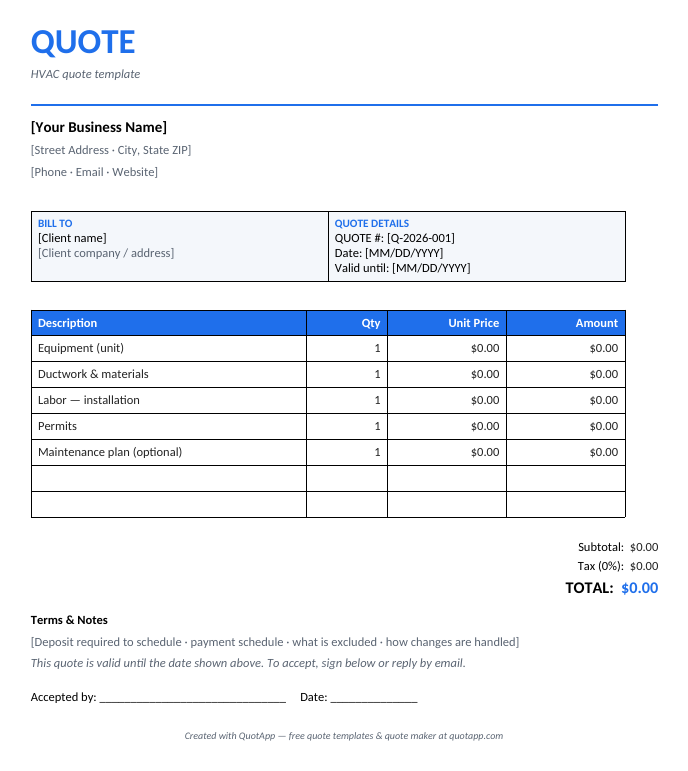
⬇ Free download — no sign-up
- HVAC Quote Template (Word) — Pre-filled with industry line items
- Quote Template (Excel, auto-calculating)
- Quote Template (PDF)
Create this quote online — free Browse all templates
Which hvac quote template do you need?
| Variant | Use it when | What changes in the template |
|---|---|---|
| System replacement / installation | New furnace, AC condenser, heat pump or full system change-out. | Equipment listed by brand, model, tonnage/BTU and SEER2/AFUE; line items for pad, line set, thermostat, electrical, permit, disposal; warranty terms (parts vs labor) and rebate paperwork noted; good/better/best options priced. |
| Repair | Diagnosed fault — capacitor, blower motor, refrigerant leak, control board. | Diagnostic fee shown and credited if repaired; part and labor as separate lines; refrigerant by pound; note on system age and a replacement option if relevant. |
| Ductwork | New ducts, reroutes, sealing or insulation. | Priced per linear foot or per run; registers, boots and dampers as items; access difficulty (attic, crawl) as a labor factor; airflow test before and after. |
| Maintenance agreement | Annual or semi-annual tune-ups for residential or light commercial. | Price per year with visits listed; what each visit includes (filters, coil cleaning, refrigerant check); priority scheduling and repair discount stated; auto-renewal and cancellation terms. |
Filled-out hvac quote example
This is what the template looks like completed for a real job — replacement of a 3-ton central AC condenser and matching evaporator coil, existing furnace and ducts kept. Prices are illustrative US figures; swap in your own rates.
Prepared for Robert Chen, 1720 Ridgeview Dr
| Description | Qty | Unit | Unit price | Amount |
|---|---|---|---|---|
| 3-ton 16 SEER2 condensing unit, R-454B, with matched evaporator coil | 1 | system | $4,650.00 | $4,650.00 |
| New composite pad, line set flush and reuse, filter drier, whip and disconnect | 1 | lot | $385.00 | $385.00 |
| Smart thermostat, Wi-Fi, installed and configured | 1 | unit | $265.00 | $265.00 |
| Installation labor — 2 technicians, removal, set, braze, evacuate, charge, start-up | 8 | hours | $135.00 | $1,080.00 |
| Mechanical permit and inspection | 1 | permit | $180.00 | $180.00 |
| Old equipment removal and refrigerant recovery/disposal | 1 | lot | $150.00 | $150.00 |
Equipment: 3-ton 16 SEER2 condenser and matched coil, 10-year parts warranty (registered), 2-year labor warranty. Price includes permit, inspection scheduling, refrigerant charge, start-up and old equipment disposal. Utility rebate ($400) applied for on your behalf and not deducted here. Excludes ductwork repairs and electrical panel upgrades. 30% deposit, balance on start-up. Quote valid 21 days.
Rebuild this example in the free quote generator and export it as a PDF in under a minute.
Typical hvac prices in the US
Use these ranges to sanity-check your line items, not to set them — your labor rate, market and overhead decide the final number.
| Item | Typical range | Notes |
|---|---|---|
| HVAC technician labor rate | $75 – $150 per hour | Emergency: $140 – $250/hr, up to $400 – $600 |
| Service call / diagnostic fee | $75 – $200 | Usually credited toward the repair |
| Full HVAC system replacement | $5,000 – $11,000 | Central AC alone $3,500 – $10,000; furnace $3,000 – $7,000 |
| New ductwork | $10 – $25 per linear foot | Duct cleaning $450 – $1,000 |
| Tune-up / maintenance visit | $70 – $200 | Annual plans $150 – $500 per year |
| Capacitor replacement | $100 – $250 | |
| Refrigerant recharge | $100 – $600 | Depends on refrigerant type and pounds |
| Blower motor replacement | $300 – $900 | |
| Compressor replacement | $1,300 – $2,500 | Often the point to quote a new system instead |
Source: HomeGuide — HVAC Repair Cost; Housecall Pro — HVAC Pricing Guide, updated July 2025 / July 2026. Ranges are national; adjust for your region.
How to price an HVAC job, step by step
HVAC quotes lose on two things: a number that is not comparable to the other bids, and a scope that does not say what happens to the ductwork. The process behind the example above:
- Size the system properly and write the result on the quote. A Manual J load calculation (or at minimum a documented rule-of-thumb check) tells the client the tonnage is not a guess. Oversizing is the most common reason a change-out disappoints.
- List the equipment precisely. Brand, model numbers for indoor and outdoor units, capacity, SEER2/HSPF2/AFUE, refrigerant type. Precision protects you when the client compares bids and when the inspector shows up.
- Separate the parts of the job. Equipment, accessories (pad, line set, drain, thermostat, electrical whip and disconnect), labor, permit, disposal. Even if you present one installed price, build it from these lines internally.
- Estimate labor from your crew’s real hours. A straightforward split-system change-out is 6–10 technician hours for two people; add for attic units, crane lifts, line-set replacement, or converting refrigerants. Price hours at your loaded cost — the labor cost calculator gets you the number — then add margin.
- Mark up equipment and materials. Distributor cost plus your markup; 25–50% on equipment is common in residential, less in commercial bids. Use the markup calculator to convert the margin you want into the markup.
- Add permit, disposal and rebate work. The permit protects the client and you; refrigerant recovery is regulated; rebate paperwork is labor. All three belong on the quote even when you absorb them.
- Present options. Good/better/best — a 14.3 SEER2 baseline, a 16 SEER2 mid-tier, a variable-speed heat pump — each as an installed price with warranty and estimated annual energy cost. Clients choose a tier; they rarely choose “no”.
What to include in an HVAC quote
- Header: company name, HVAC license number, EPA 608 certification, insurance, phone and email.
- Client and site address, plus the equipment location (attic, closet, side yard) and access notes.
- Quote number, date and validity.
- Load calculation summary or existing system data: square footage, current equipment age and capacity, the reason for the recommendation.
- Equipment lines with full model numbers and ratings.
- Accessories and materials.
- Labor with the crew size and estimated duration (“one day, two technicians”).
- Permit, inspection, disposal.
- Warranty: manufacturer parts warranty (and the registration requirement), your labor warranty, and what voids either.
- Rebates and financing: what you will file, what the client can expect, and financing terms if offered.
- Exclusions: duct repairs, electrical panel work, drywall, asbestos or mold abatement, condensate pump unless listed.
- Terms: deposit, balance on start-up, change orders, scheduling contingencies.
- Acceptance: signature, date, and selected option if you presented tiers.
Installation, repair, ductwork and maintenance quotes
Installations are compared side by side, so make yours comparable: same structure every time, model numbers visible, warranty explicit. Attach the load calculation as page two for jobs over $8,000.
Repairs are priced flat-rate in most of the US: a diagnostic fee, then a fixed price per repair drawn from your rate book. Show the diagnostic on the quote and whether it is credited; list refrigerant by the pound because the client will ask. When the repair is more than a third of replacement cost, put a replacement option on the same document.
Ductwork is priced per linear foot or per run with registers, boots and dampers itemized and an access factor for attics and crawlspaces. Quote a before-and-after airflow or static pressure test — it demonstrates value and protects you from “it still doesn’t cool the back bedroom”.
Maintenance agreements are annual prices with the visit schedule, inclusions, repair discount and renewal terms. Offer the agreement on every install quote; the attach rate is highest at that moment.
Common mistakes that cost HVAC companies money
- Quoting tonnage without a load calculation. The client’s brother-in-law says 4 tons; your 3-ton quote loses unless you show why.
- Vague equipment description. “16 SEER AC” lets the client compare your Trane to a bid for an entry-level unit.
- Forgetting the small parts. Pad, whip, disconnect, filter drier, drain line and thermostat add $300–$600 that comes out of margin when left off.
- Absorbing permits and disposal silently. List them, even at $0, so the client sees you did them.
- No refrigerant clause on repairs. Leaks that need more refrigerant than expected become your cost without a per-pound line.
- One option. A single price invites a yes/no; three prices invite a choice.
- Long validity. Equipment prices and rebate programs move; 21 days is enough.
Quote or estimate for HVAC work?
Send a quote — fixed installed price — when you have surveyed the site, sized the system and seen the electrical panel and ductwork. Send an estimate when you are pricing from a phone call, a new-construction plan set without a site visit, or a system with unknown duct condition; state the assumptions and add an allowance line. The HVAC estimate template is the same layout with estimate wording and a contingency row. Details in quote vs estimate.
Sending the quote and following up
Send the PDF the same day as the visit, with the options summarized in the email body: three installed prices, warranties, and the earliest install date. Homeowners typically collect three bids within a week; the one that arrives first and reads clearest sets the anchor. Follow up on day 2 and day 7 — the follow-up sequence has wording — and offer to walk through the load calculation. On acceptance, the chosen option’s line items become the invoice; the free quote generator exports both.
Frequently asked questions
What should an HVAC quote include?
Your license and insurance numbers, the client's name and address, quote number and date, equipment by brand, model, capacity and efficiency rating, line items for accessories, labor, permit and disposal, warranty terms for parts and labor separately, rebates you will file, exclusions (ductwork, electrical, drywall), payment terms, validity and a signature line. The example above shows a typical AC replacement.
How do I price an HVAC installation?
Equipment cost plus your markup, plus accessories (pad, line set, thermostat, electrical), plus labor hours × your loaded rate, plus permit and disposal, plus overhead and profit. Most residential change-outs take 6 – 10 technician hours. Offer good/better/best equipment tiers on the same quote — it moves the conversation from 'how much' to 'which one'.
Should I show the equipment price separately from labor?
Many HVAC companies quote a single installed price per option to avoid clients shopping the equipment online. The template supports both: keep separate lines when you want transparency (commercial, insurance work) or collapse them into one 'installed system' line with the model number for residential sales. Either way, list the warranty.
How do I quote an HVAC repair?
Show the diagnostic fee, then the repair as part + labor, and state whether the diagnostic is credited. Add refrigerant by the pound if needed. If the system is over 12 years old or the repair exceeds roughly 30 – 40% of a replacement, add a replacement option to the same quote.
What is a good HVAC maintenance agreement price?
US plans typically run $150 – $500 per year for two visits. List what each visit includes, the repair discount and priority scheduling, and the renewal terms. Selling the agreement on the install quote raises lifetime value more than any discount.
Quote or estimate for HVAC work?
Quote when you have done a load calculation or site visit and know the equipment and access. Estimate when you have not seen the ductwork, electrical panel or attic — say what you assumed and add an allowance. The estimate version of the template is linked from the estimate templates hub.
How long should an HVAC quote be valid?
14 – 30 days. Equipment prices and rebate programs change often; 21 days with the date printed is a reasonable middle.
Related tools and templates
- HVAC estimate template — for jobs you have not surveyed yet
- Free quote generator — build this quote online
- Markup calculator — price equipment with your margin
- Labor cost calculator — your true cost per technician hour
- Electrical quote template
More quote templates
Skip the template. Build it online.
The free QuotApp quote maker fills in the math, formats everything professionally, and gives you a ready-to-send PDF in under a minute.
Create a free quote now