Job Estimate Template
By QuotApp Team · Updated October 17, 2026
A job estimate template (also called a work estimate template) is a pre-formatted document for giving a customer an approximate price before the scope is final: labor, materials, other costs, a contingency, the assumptions behind each number and a note on how accurate it is. It works for any trade or service. Download the free Word, Excel or PDF version below, copy the filled-out example, or build it online with the free estimate generator.
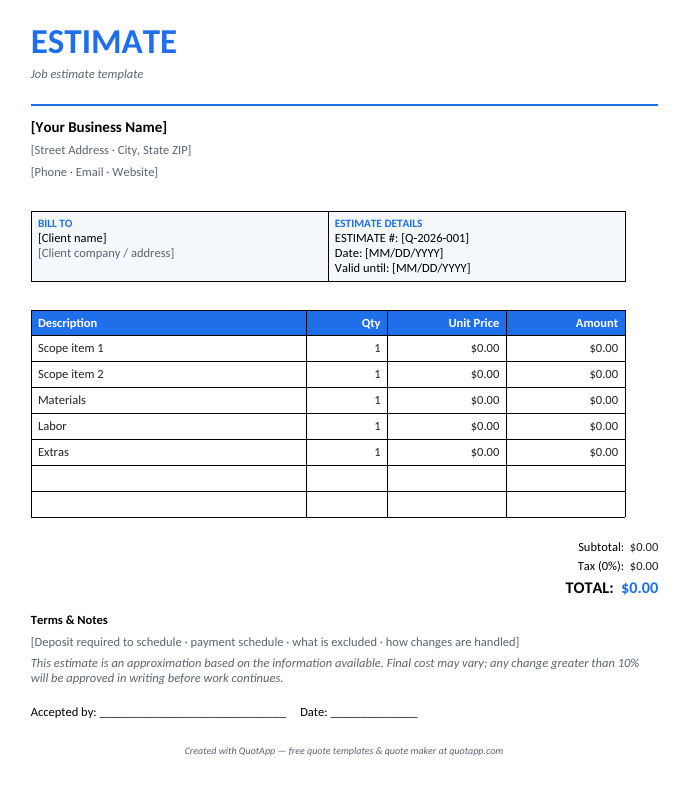
⬇ Free download — no sign-up
- Job Estimate Template (Word) — Pre-filled with industry line items
- Estimate Template (Excel, auto-calculating)
- Estimate Template (PDF)
Create this estimate online — free Browse all templates
Which job estimate template do you need?
| Variant | Use it when | What changes in the template |
|---|---|---|
| Ballpark / budget estimate | First call or first visit; the customer wants to know if the project is affordable. | Ranges per section instead of single numbers; no line-level detail; clear statement that it is not a price. |
| Detailed estimate | You have seen the job and measured, but some conditions are still unknown. | Line items with quantities and unit prices; allowances for selections; contingency line; assumptions listed; converts to a quote after confirmation. |
| Time-and-materials estimate | Repairs or service work where hours cannot be known in advance. | Hourly rate, estimated hours range, materials at cost plus markup, a not-to-exceed figure the customer approves. |
| Insurance or third-party estimate | The payer is an insurer, landlord or property manager. | Line items in the payer's format; photos and measurements attached; supplements listed separately. |
Filled-out job estimate example
This is what the template looks like completed for a real job — replace a rotted 12×14 ft deck surface and railing on an existing frame — frame condition to be confirmed once old boards are removed. Prices are illustrative US figures; swap in your own rates.
Prepared for Andre Lewis, 19 Birch Way
| Description | Qty | Unit | Unit price | Amount |
|---|---|---|---|---|
| Remove and haul away existing deck boards and railing | 1 | lot | $650.00 | $650.00 |
| Deck boards — ALLOWANCE, 5/4 pressure-treated, installed with hidden fasteners | 168 | sq ft | $11.50 | $1,932.00 |
| Railing — pressure-treated with balusters, installed | 34 | lin ft | $48.00 | $1,632.00 |
| Stairs — 3 treads, stringers re-used if sound | 1 | lot | $420.00 | $420.00 |
| Fasteners, joist tape, hardware and consumables | 1 | lot | $310.00 | $310.00 |
| Contingency — joist repairs if needed (10%) | 1 | lot | $494.00 | $494.00 |
ESTIMATE — not a fixed price. Assumes the existing joists and beams are sound and to code; if replacement framing is needed it will be priced before any work continues. Decking ALLOWANCE assumes pressure-treated 5/4 boards; composite upgrade available (estimated +$2,100). Contingency covers up to 4 joist sister repairs; unused contingency is not billed. Accuracy: expect ±15% until the frame is inspected. Valid 30 days; a fixed quote follows the inspection.
Rebuild this example in the free estimate generator and export it as a PDF in under a minute.
When to send an estimate instead of a quote
Send an estimate whenever you would otherwise have to guess. The customer gets a realistic number to plan with, and you keep the right to confirm the price once the unknowns are resolved. Typical situations:
- You have not seen the job yet — pricing from a phone call, photos or a listing.
- Something is hidden — framing under deck boards, pipes behind walls, wiring in an old house, decking under shingles.
- Selections are not made — the customer has not chosen fixtures, finishes or materials.
- The scope may change — the customer is still deciding what they want.
- The work is diagnostic — repairs where the cause has to be found first.
If none of these apply, send a quote. A fixed price wins more work than a range when you can give one honestly. The difference is covered in depth in quote vs estimate.
How to write a job estimate, step by step
- Describe the work in one paragraph. What will be done, where, and the result. “Replace deck boards and railing on the existing 12×14 frame” is clear; “deck work” is not.
- List the line items. Removal, materials, installation, accessories, disposal — whatever the job needs, with quantities and units. Even approximate quantities make an estimate believable.
- Price labor from real hours. Estimate hours from your production on similar jobs and multiply by your loaded hourly cost, then add margin. The labor cost calculator gives you the cost side.
- Mark allowances. For items the customer has not selected, use a realistic allowance and say so on the line: “ALLOWANCE, 5/4 pressure-treated.”
- Write the assumptions. Every unknown you priced around becomes a sentence: “Assumes existing joists are sound.” This is what lets you change the number later without an argument.
- Add a contingency. 5–15% depending on how much is hidden, on its own line, with what it covers and that it is not billed if unused.
- State the accuracy and next step. “±15% until the frame is inspected; a fixed quote follows.”
- Send it as a PDF with a short email that repeats the total, the main assumption and the next step.
The full method — production rates, overhead and profit, with a worked numeric example — is in how to estimate a job.
Accuracy by stage
| Stage | Typical basis | Typical accuracy | What to send |
|---|---|---|---|
| First call | Description, photos | Wide range (±25–50%) | Ballpark range, no line items |
| Site visit | Measurements, inspection of visible work | ±10–20% | Detailed estimate with assumptions |
| Unknowns resolved | Inspection, selections made | Firm | Quote |
| During the job | Approved changes | Exact | Change order |
These ranges are rules of thumb, not standards; your trade and your records should set your own.
What to include in a job estimate
- Header: business name, license and insurance where relevant, contact.
- Customer and job address.
- Estimate number, date and validity. Use a different prefix from quotes (E-2026-014 vs Q-2026-014) so both can be referenced later.
- The word ESTIMATE in the heading, plus a sentence that it is not a fixed price.
- Description of the work.
- Line items with quantities, units and unit prices.
- Allowances, marked.
- Contingency, on its own line.
- Assumptions and exclusions.
- Accuracy statement and next step.
- Optional: upgrade options priced separately (e.g., composite decking).
Estimate templates by trade
This general template works for most jobs. For trades with specific conventions, use the versions with worked examples: remodeling (allowances by phase), electrical (panel and utility unknowns), plumbing (access assumptions), HVAC (provisional sizing and rebates) and landscaping (concept-stage ranges). Construction and roofing estimates are included on the construction and roofing pages.
Common estimating mistakes
- A single number with no assumptions. It becomes the price in the customer’s mind.
- Hidden contingency. Inflated unit prices get shopped; a visible 10% gets accepted.
- Low allowances to look cheaper. The overage costs you more trust than the higher estimate would have.
- No next step. Without “a fixed quote follows the inspection”, the estimate never converts.
- Exceeding the estimate without approval. Stop and get written approval before going over — in some states and trades it is required.
Frequently asked questions
What is a job estimate?
A job estimate is an approximate price for a piece of work, given before the scope or conditions are final. It lists the expected labor, materials and other costs, the assumptions behind them and how accurate the total is. Unlike a quote, it is normally not a fixed price.
What should a job estimate include?
Your business details, the customer and job address, an estimate number and date, a description of the work, line items with quantities and unit prices, allowances for anything not yet selected, a contingency, the assumptions and exclusions, an accuracy statement, validity and what happens next (usually an inspection and a fixed quote).
How accurate should a job estimate be?
It depends on the stage. Ballpark estimates from a phone call are often ±25 – 50%; estimates after a site visit with measurements are usually ±10 – 20%; and once all unknowns are resolved you should be sending a quote. Write the accuracy on the estimate itself.
Can a customer hold me to an estimate?
Generally an estimate is not a binding price, but some states regulate written estimates for certain work — for example auto repair or home improvement — and require customer approval before exceeding them by a set amount. Check the rules where you work and get written approval before going over your estimate.
How do I turn an estimate into a quote?
Resolve the assumptions (inspect, measure, confirm selections), replace allowances with actual items and prices, reduce or remove the contingency, add payment terms and a signature block, and change the heading to QUOTE. Keep the same line items so the customer can follow the changes.
Should I charge for estimates?
Simple estimates are usually free as part of selling. Detailed estimates that require design, engineering, diagnostics or several hours of takeoff are reasonable to charge for — say so before you start, and credit the fee if the customer hires you.
Related tools and templates
- Free estimate generator — build this estimate online
- How to estimate a job — 8-step method with example
- Remodeling estimate template
- Quote vs estimate: when to send each
- Labor cost calculator
More estimate templates
Skip the template. Build it online.
The free QuotApp quote maker fills in the math, formats everything professionally, and gives you a ready-to-send PDF in under a minute.
Create a free quote now