Plumbing Estimate Template
By QuotApp Team · Updated September 27, 2026
A plumbing estimate template is a pre-formatted document for the jobs you cannot price flat-rate on the spot — slab leaks, sewer lines before a camera goes in, repipes behind finished walls, remodel rough-in from a sketch. It separates fixtures and parts, labor, access work and permits, and it makes the assumptions and the contingency visible. Download the free template below (Word, Excel or PDF), copy the filled-out example, or build it online with the free estimate generator.
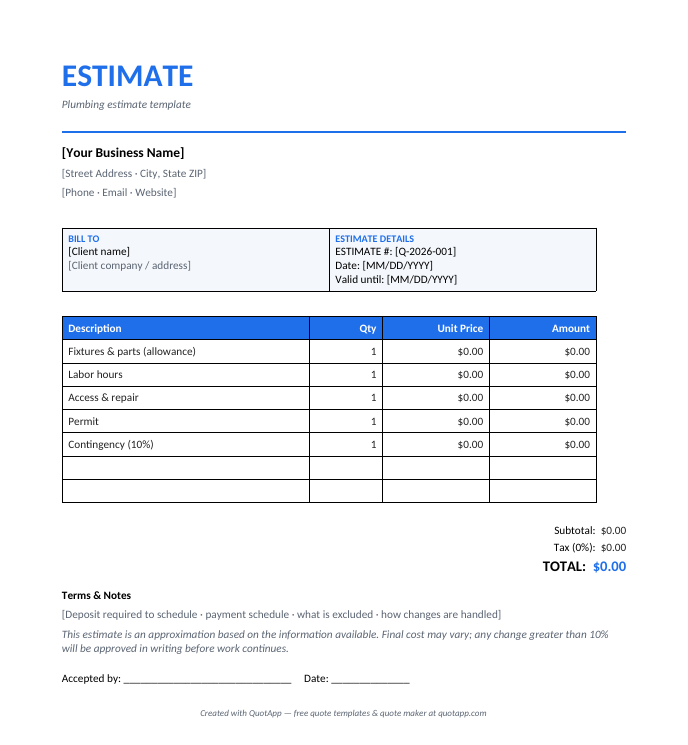
⬇ Free download — no sign-up
- Plumbing Estimate Template (Word) — Pre-filled with industry line items
- Estimate Template (Excel, auto-calculating)
- Estimate Template (PDF)
Create this estimate online — free Browse all templates
Which plumbing estimate template do you need?
| Variant | Use it when | What changes in the template |
|---|---|---|
| Remodel rough-in and trim | Bathroom or kitchen remodel priced from a layout, fixtures not yet chosen. | Per-fixture pricing for rough-in and trim; fixture allowances; two inspections; drywall opening and patching stated. |
| Leak or sewer investigation | Symptoms known, cause not — slab leak, main line backups, pressure loss. | Diagnostic step priced (camera, pressure test, leak detection); repair options with ranges; restoration excluded; converts to a quote after diagnosis. |
| Whole-house repipe | Galvanized, polybutylene or failing copper replacement. | Priced per fixture with material specified; access assumptions per area; drywall repair included or excluded; phased payments; 10–15% contingency. |
| Water heater / appliance replacement (unseen) | Pricing from a phone call or photos. | Model and code-upgrade allowances; venting and gas-line assumptions; final price confirmed on arrival. |
Filled-out plumbing estimate example
This is what the template looks like completed for a real job — hall bathroom remodel — relocate the vanity 3 ft, replace tub with a tiled shower, new toilet; fixtures to be selected by the client. Prices are illustrative US figures; swap in your own rates.
Prepared for Miguel & Dana Reyes, 77 Harbor View Ln
| Description | Qty | Unit | Unit price | Amount |
|---|---|---|---|---|
| Rough-in — relocate vanity supply and drain 3 ft, new shower valve and drain, toilet flange reset | 3 | fixture | $685.00 | $2,055.00 |
| Shower valve and trim — ALLOWANCE (pressure-balanced, mid-range) | 1 | set | $320.00 | $320.00 |
| Vanity faucet, supplies and P-trap — ALLOWANCE | 1 | set | $240.00 | $240.00 |
| Toilet, elongated, 1.28 gpf — ALLOWANCE, supplied and set | 1 | unit | $390.00 | $390.00 |
| Trim-out labor — set fixtures, connect, test after tile | 5 | hours | $125.00 | $625.00 |
| Plumbing permit and two inspections (rough, final) | 1 | permit | $210.00 | $210.00 |
| Tub removal and disposal | 1 | lot | $180.00 | $180.00 |
| Contingency — concealed pipe condition found at demo (12%) | 1 | lot | $472.00 | $472.00 |
ESTIMATE — final quote after demolition exposes existing drain and supply lines. Assumes wood-framed floor with crawlspace access below the bathroom, copper supplies in serviceable condition, and existing 2" drain reusable for the shower. Fixture allowances shown at mid-range retail; client selections above the allowance are added at cost plus 20%. Excludes tile, drywall patching, electrical and finish carpentry. Contingency covers corroded or undersized lines found at demo; unused contingency is not billed. Expect ±15%.
Rebuild this example in the free estimate generator and export it as a PDF in under a minute.
Typical plumbing prices in the US
Use these ranges to sanity-check your line items, not to set them — your labor rate, market and overhead decide the final number.
| Item | Typical range | Notes |
|---|---|---|
| Plumber hourly rate | $45 – $150 per hour | Master $75 – $125; commercial ≈ $85 |
| Emergency / after-hours | $125 – $170 per hour | Or 1.5× – 3× standard |
| Service call fee | $50 – $200 | Flat-rate minimum $200 – $250 |
| Leak repair | $150 – $850 | Access drives the range |
| Drain cleaning | $100 – $275 | |
| Toilet installation | $250 – $750 | |
| Faucet installation | $120 – $300 | |
| Water heater installation | $600 – $1,800 | Plus unit in many quotes |
| Whole-house repipe | $2,280 – $5,120 |
Source: HomeGuide — Plumber Cost, updated September 25, 2023. Ranges are national; adjust for your region.
How to estimate plumbing work you cannot see
Flat-rate pricing works when you can see the failed part. Everything else — remodels before demo, leaks behind slabs, sewer lines, repipes — needs an estimate that tells the client what you assumed and what would change the number. The method behind the example above:
- Separate the visible from the concealed. Fixture counts, room layout and code requirements are visible; pipe condition, routing and access are not until demolition or a camera.
- Price the visible work per fixture. Rough-in per fixture, trim-out per fixture, using your real times × your loaded hourly cost (the labor cost calculator gives you the cost; add margin).
- Use allowances for client selections. Valves, faucets, toilets, showerheads at mid-range retail, with the rule for selections above the allowance written on the estimate.
- Write the access and condition assumptions. Crawlspace vs slab, supply material, drain size, reuse of existing lines. Each assumption is a change order you can charge for if it proves wrong.
- Add a contingency of 10–15% as a line, and state that unused contingency is not billed.
- Name the conversion trigger. Demolition day, camera inspection, pressure test — the moment the estimate becomes a quote.
- List permits, inspections, removal and disposal — the items that are certain even when the pipe condition is not.
What to include in a plumbing estimate
- Header with plumbing license, insurance, phone and email.
- Client, job address, date, estimate number, validity.
- The word ESTIMATE, the accuracy range and the conversion trigger.
- Line items: rough-in per fixture, fixture allowances, trim labor, permit and inspections, removal and disposal, contingency.
- Assumptions on access, existing materials and reuse.
- Exclusions: tile, drywall, electrical, finish carpentry, restoration after sewer work.
- Payment terms that will apply to the quote (deposit, rough-in inspection, final).
Leak, sewer and repipe estimates
For leaks and sewer lines, put the diagnostic step first as a priced line — leak detection, pressure test, camera inspection with video — and present the repair as options with ranges (spot repair vs section replacement vs full line). State that restoration (concrete, landscaping, flooring) is excluded or priced separately.
For repipes, price per fixture with the material named (PEX vs copper), an access assumption per area of the house, drywall repair included or excluded, and phased payments. Contingency 10–15%.
For unseen appliance replacements, list the unit and code-upgrade kit as allowances, state venting and gas assumptions, and mark the total “confirmed on arrival before work begins”.
Common plumbing estimating mistakes
- Estimating a remodel without a fixture count. Per-fixture pricing is the only basis the client can check.
- No access assumption. Slab vs crawlspace can triple the labor.
- Fixtures guessed instead of allowed. The client’s selections become your margin problem.
- Restoration left ambiguous on sewer work. Concrete and landscaping repair are more expensive than the pipe.
- Contingency hidden in the rate. A visible 12% is accepted; a mysteriously high per-fixture price is shopped.
- No conversion trigger. Without it, the estimate becomes the price in the client’s mind.
Frequently asked questions
When should a plumber send an estimate instead of a flat-rate quote?
When the cause or the conditions are not visible: slab leaks, sewer lines before a camera inspection, repipes behind finished walls, remodel rough-in without demolition, or any job you are pricing from photos. Give the number as an estimate with assumptions and a contingency, and convert it to a quote once you can see the work.
How do I estimate a bathroom remodel plumbing job?
Price the rough-in per fixture (supply and drain relocation, valve, flange), the trim-out labor per fixture, permits and inspections, removal and disposal, and use allowances for fixtures the client has not selected. Add a 10 – 15% contingency for what demolition reveals. The example above shows a three-fixture bathroom estimated this way.
What should a plumbing estimate say about access?
State the assumption: crawlspace, basement, slab, finished walls. Access is the biggest driver of plumbing labor. If the assumption turns out wrong, the estimate says the price changes — which is exactly what a contingency and a conversion clause are for.
How much contingency for a repipe?
10 – 15%. Repipes in older homes routinely uncover undersized drains, hidden junctions or rotten framing. Show the contingency as a line and state that unused contingency is not billed.
Should the estimate include drywall repair?
Say clearly whether it does. Many plumbers exclude drywall and finish work and recommend a drywall contractor; others include rough patching only. Ambiguity here is the most common remodel dispute.
How do I convert the estimate to a quote after demolition?
Keep the same line items, replace allowances with the selected fixtures, confirm the rough-in count and hours, remove or reduce the contingency, add the warranty and payment schedule, and change the heading. The free estimate generator switches between estimate and quote in one click.
Related tools and templates
- Plumbing quote template — for diagnosed repairs and installs
- Free estimate generator — build this estimate online
- Hourly rate calculator — set your billable rate
- Remodeling estimate template
- How to estimate a job in 6 steps
More estimate templates
Skip the template. Build it online.
The free QuotApp quote maker fills in the math, formats everything professionally, and gives you a ready-to-send PDF in under a minute.
Create a free quote now