Markup Calculator
Enter your cost and the markup you apply to get the selling price, profit and the margin you actually keep — or enter the margin you want and get the markup that produces it. Markup is measured on cost; margin is measured on price. They are not the same number, and quoting with the wrong one is how a "40% markup" becomes a 28.6% margin.
Cost → price
Target margin → required markup
The formulas
Markup = (Price − Cost) ÷ Cost
Margin = (Price − Cost) ÷ Price
Markup needed for a target margin = Margin ÷ (1 − Margin)
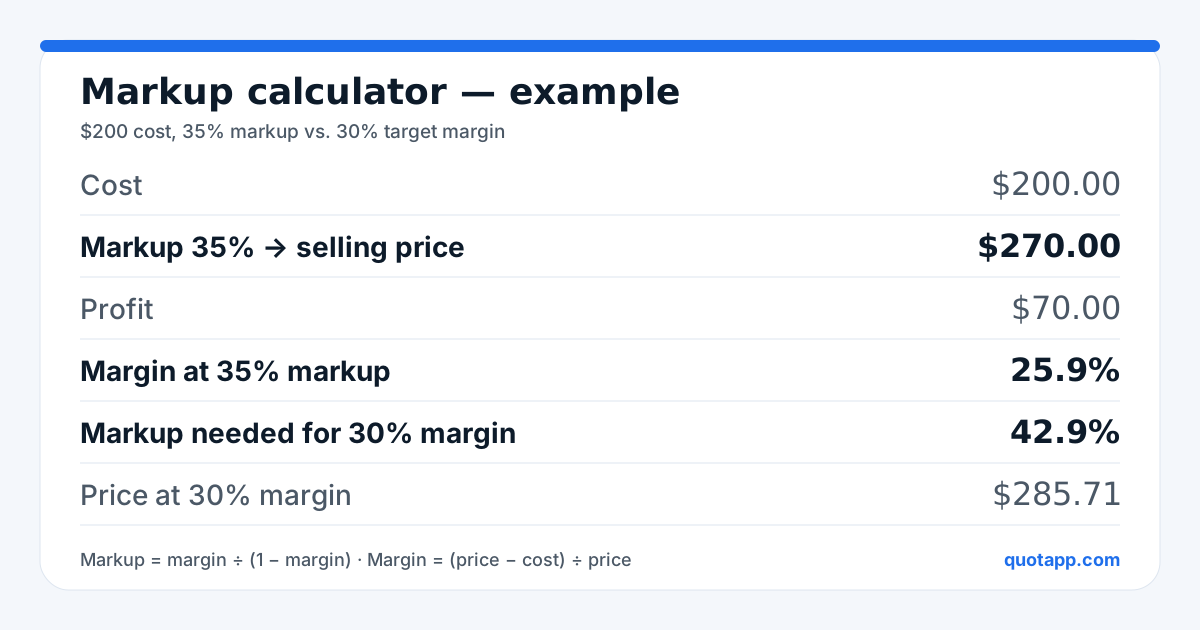
Example: a $200 part at 35% markup → price $270, profit $70, margin $70 ÷ $270 = 25.9%. To keep a 30% margin on that part you need 0.30 ÷ 0.70 = 42.9% markup → price $285.71.
Markup to margin conversion table
| Markup on cost | Margin on price | Price of a $100 cost |
|---|---|---|
| 10% | 9.1% | $110 |
| 15% | 13.0% | $115 |
| 20% | 16.7% | $120 |
| 25% | 20.0% | $125 |
| 30% | 23.1% | $130 |
| 35% | 25.9% | $135 |
| 40% | 28.6% | $140 |
| 50% | 33.3% | $150 |
| 60% | 37.5% | $160 |
| 75% | 42.9% | $175 |
| 100% | 50.0% | $200 |
How to use markup on a quote
- Decide the margin your business needs, from your overhead and profit target — not from a rule of thumb. The hourly rate calculator shows the math for labor; materials should carry a share of overhead too.
- Convert that margin into a markup with the second box above and apply it to your material cost per line.
- Keep labor and materials separate on the quote. Labor priced from your loaded rate (labor cost calculator), materials at cost plus markup. Clients accept itemized quotes faster and you can offer a cheaper material grade without touching labor.
- Use different markups for different item classes. Small parts and consumables carry procurement time out of proportion to their cost; equipment carries warranty risk. Trade guides put general materials at roughly 15–30%, HVAC equipment and plumbing fixtures at 25–50%, small parts at 50–100%; general contractors commonly apply 10–15% to the whole project (HomeGuide).
- Add tax after markup, as its own line, where materials are taxable.
Worked examples by trade
- Painting: 18 gallons at $42 = $756 cost; 25% markup → $945 on the quote (20% margin). See the painting quote example.
- HVAC: a $3,900 condenser and coil at 40% markup → $5,460 installed-equipment line (28.6% margin). See the HVAC quote example.
- Plumbing: a $28 fill valve at 100% markup → $56; the labor line carries the rest. See the plumbing quote example.
- Landscaping: $2,100 of plants at 35% markup → $2,835 (25.9% margin) plus the installation labor line. See the landscaping quote example.
Frequently asked questions
What is the difference between markup and margin?
Markup is the percentage added to cost to get the price: (price − cost) ÷ cost. Margin is the percentage of the price that is profit: (price − cost) ÷ price. A 50% markup is a 33.3% margin; a 50% margin needs a 100% markup. Confusing the two is the most common pricing error in small business.
How do I calculate selling price from cost and markup?
Price = cost × (1 + markup). A $200 part with a 35% markup sells for $270. The calculator does this and also shows the margin that markup produces (25.9% in that example).
How do I convert a target margin into a markup?
Markup = margin ÷ (1 − margin). For a 30% margin: 0.30 ÷ 0.70 = 42.9% markup. Enter your target margin in the second box and the calculator returns the markup to apply and the resulting price.
What is a typical markup on materials for contractors?
Ranges reported by trade pricing guides run roughly 15 – 30% on paint and general materials, 25 – 50% on HVAC equipment and plumbing fixtures, and 50 – 100% on small parts. General contractors commonly apply 10 – 15% on the whole project (HomeGuide). Your overhead, not the industry average, should set yours.
Should I mark up labor as well as materials?
Yes. Your labor rate on a quote should already include overhead and profit — see the labor cost calculator and the hourly rate calculator. The materials markup covers procurement time, warranty risk, delivery and the cash you tie up.
Does markup include sales tax?
No. Apply markup to your pre-tax cost, then add sales tax on the quote where it applies to materials. The quote generator adds tax as a separate line.
Now put the price on a quote
Itemized lines, tax and total, exported as a PDF — free, no account.
Create a free quote now