Labor Cost Calculator
Enter an hourly wage and what you pay on top of it, and get the fully loaded cost per hour — and the higher billable cost per hour once drive time, quoting and shop time are counted. That second number is what a labor line on a quote has to recover before you make any profit.
The formulas
Working hours/year = paid hours − PTO days × (hours per week ÷ 5)
Annual wage cost = wage × paid hours
Annual burden = wage cost × (payroll tax % + insurance %) + benefits + other costs
Loaded cost per paid hour = (wage cost + burden) ÷ paid hours
Billable hours = working hours × (1 − non-billable %)
Billable cost per hour = (wage cost + burden) ÷ billable hours
Rate at margin m = billable cost ÷ (1 − m)
Where the defaults come from
- Payroll taxes 10%: employer FICA is 7.65% (6.2% Social Security + 1.45% Medicare); federal and state unemployment add roughly 1–4% on the first several thousand dollars of wages. Check your state rate.
- Workers' comp and liability 8%: trade classifications vary widely — office work under 1%, roofing well above 10%. Use the rate on your policy.
- PTO 15 days: 10 vacation/sick days plus 5 paid holidays. Paid days are still paid; they just cannot be billed.
- Non-billable 25%: field-service businesses typically bill 60–80% of paid hours once drive time, quoting, shop and training are counted. Measure yours for a month.
Worked example
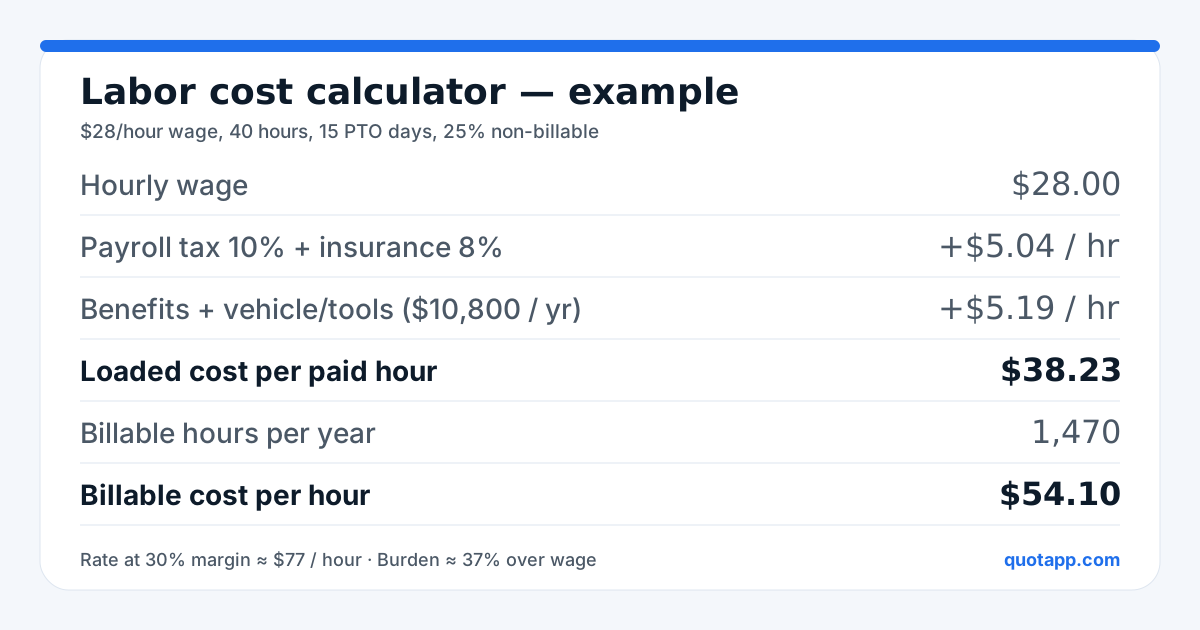
A painter at $28/hour, 40 paid hours a week: wage cost $58,240; payroll taxes and insurance at 18% add $10,483; benefits $6,000 and vehicle/phone/tools $4,800 bring the annual cost to about $79,500. Divided by 2,080 paid hours that is about $38 loaded — but with 15 PTO days and 25% non-billable time only about 1,470 hours can be billed, so each billable hour costs about $54. To earn a 30% margin on labor, the quote needs to price that painter's hour at roughly $77. This is why a $28 wage cannot be billed at $45.
Using it on a quote
- Run each role (lead, helper, apprentice) through the calculator and keep the billable cost per hour on a sheet.
- Estimate crew hours for the job from your production rates — the industry pages have benchmarks for painting, cleaning, HVAC, landscaping and plumbing.
- Multiply, then add your margin (the markup calculator converts margin to markup). Show hours × rate on the quote or fold it into a flat price — either way the number is defensible.
- If you are the only worker, use the hourly rate calculator instead: it starts from the income you need rather than a wage.
Frequently asked questions
How do I calculate labor cost per hour?
Start with the hourly wage, add employer payroll taxes (Social Security and Medicare at 7.65%, plus federal and state unemployment), workers' compensation insurance as a percentage of wages, the hourly value of benefits and paid time off, then divide by the share of paid hours that are actually billable to a client. The result is the loaded, billable labor cost per hour — the number a quote must recover before profit.
What is a labor burden rate?
The percentage added to base wages to cover taxes, insurance, benefits and paid time off. For US trades and service businesses it commonly lands between 25% and 40% of wages before accounting for non-billable time; with unbillable hours included, the fully loaded cost is often 1.5 – 2× the wage.
What counts as non-billable time?
Paid hours you cannot charge to a job: drive time between jobs, shop time, quoting and site visits, training, meetings, loading and cleanup, callbacks. Field-service businesses typically bill 60 – 80% of paid hours; the calculator defaults to 25% non-billable.
How do I calculate labor cost for a job?
Estimate the crew hours the job needs, multiply by each worker's loaded billable cost per hour, then add your profit margin — the markup calculator converts margin to markup. Put the result on the quote as the labor line, ideally with the hours shown.
Should I include the owner's time?
Yes, at a real wage, if the owner works on jobs. Owners who price their own hours at zero build businesses that cannot hire a replacement.
What about subcontractors?
Their invoice is your cost; add your markup for supervision, warranty and risk (commonly 10 – 20%). No burden calculation is needed because they carry their own.
Put the labor line on a quote
Hours × rate, materials, tax and total — exported as a PDF in under a minute.
Create a free quote now