Hourly Rate Calculator
Enter the income you need, your yearly business costs, the hours you can bill and the profit you want, and get the hourly rate to charge — with the break-even rate and a day rate. The rate is built from your numbers, not from what competitors charge; compare it to the market afterwards.
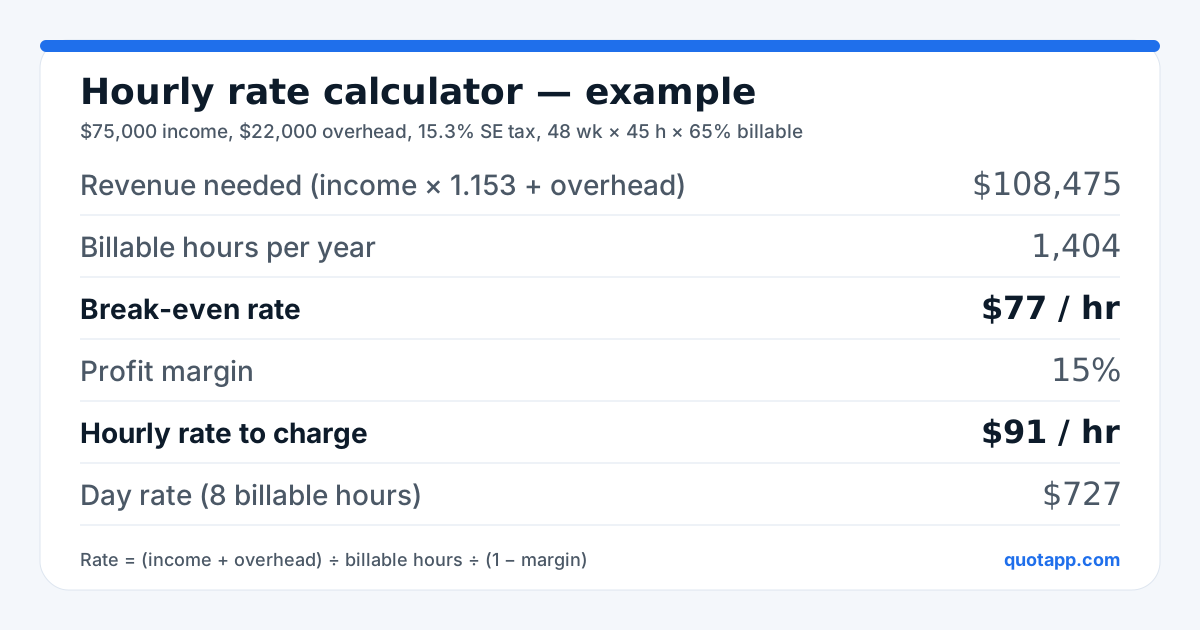
The formulas
Revenue needed = income × (1 + self-employment tax) + overhead
Break-even rate = revenue needed ÷ billable hours
Hourly rate = break-even rate ÷ (1 − profit margin)
Day rate = hourly rate × 8
Worked example
You want $75,000 before income tax. Self-employment tax at 15.3% means the business must generate about $86,500 for you, plus $22,000 of overhead: $108,500 of revenue. At 48 weeks × 45 hours × 65% billable you have about 1,404 billable hours, so break-even is about $77 per hour. Adding a 15% profit margin gives roughly $91 per hour, or about $730 per day. Change the billable share to 80% and the rate drops to about $74; drop to 50% and it climbs past $118. Billable share is the lever most people ignore.
Where the inputs come from
- Income: what you would need to be paid as an employee doing this work, including the value of benefits you now buy yourself.
- Overhead: last year's business expenses excluding materials and subcontractors you passed through to jobs. If you are new, list them: vehicle, fuel, insurance, tools, phone, software, licenses, marketing, accounting, workspace.
- Self-employment tax: 15.3% on net earnings in the US (Social Security and Medicare); set to 0 if you pay yourself a salary through a company that already accounts for it.
- Billable share: measure a typical month. Quoting, travel, admin and marketing usually take 30–40% of a solo operator's time.
- Margin: what the business keeps after paying you. 10–20% is common; more if you carry warranty risk or seasonal downtime.
From hourly rate to a quote
Most clients never see the hourly rate; they see a price. Estimate the hours for the job, multiply by your rate, add materials with markup (the markup calculator), and present the total on an itemized quote — the free quote generator does the formatting. Industry pages have production benchmarks to estimate hours: painting, cleaning, landscaping, plumbing, HVAC. If you employ people, price their hours with the labor cost calculator.
Frequently asked questions
How do I calculate my hourly rate as a freelancer or contractor?
Add the annual income you need to the annual cost of running the business (overhead), divide by the hours you can actually bill in a year, then add a profit margin. The calculator does this: rate = (income + overhead) ÷ billable hours ÷ (1 − margin). Most people's first surprise is how few hours are billable.
How many billable hours are there in a year?
A 40-hour week for 48 weeks is 1,920 paid hours; at 60 – 70% billable (the rest is quoting, admin, travel, marketing) that is 1,150 – 1,350 billable hours. Solo tradespeople and consultants who assume 2,000 billable hours underprice by a third.
What overhead should I include?
Everything the business pays that a job does not: vehicle and fuel, tools and equipment, insurance, software and phone, licenses, marketing, accounting, workspace, and your own health insurance and retirement if you are self-employed. Also add self-employment tax (15.3% on net earnings in the US) if your income figure is what you want to keep.
What profit margin should I add?
Profit is separate from your salary — it is what the business earns for the risk and for growth. 10 – 20% is typical for small service businesses; the painting guide cited on our painting page recommends 20 – 40% margin targets for painting companies. Set it consciously rather than leaving it at zero.
Should I charge hourly or flat rate?
Calculate your hourly rate either way — it is the basis of every flat price. Quote flat rates to clients when you know the job well (most trades do); quote hourly with an estimate of hours when the scope is open. Flat rates reward efficiency; hourly rates protect against unknowns.
How does this relate to the labor cost calculator?
The labor cost calculator prices an employee's hour from their wage and burden. This calculator prices your own hour from the income you need. If you employ people and also work on jobs, run both: your rate from here, theirs from the labor cost calculator.
Turn the rate into a quote
Hours × rate, materials, tax and total — free, no account, PDF in a minute.
Create a free quote now