Handyman Quote Template
By QuotApp Team · Updated October 17, 2026
A handyman quote template is a pre-formatted document that lists every task on a visit with its own price — repairs, installs, assembly, small carpentry and paint — plus materials, the trip or minimum charge and what is not included, so small jobs stop turning into disputes. Download the free Word template below, copy the filled-out task-list example, or build the quote online with the free quote generator.
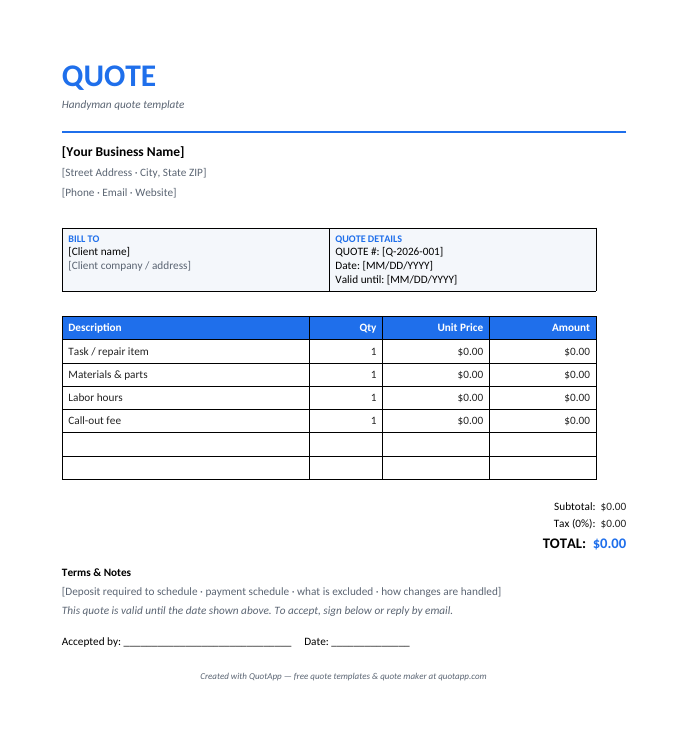
⬇ Free download — no sign-up
- Handyman Quote Template (Word) — Pre-filled with industry line items
- Quote Template (Excel, auto-calculating)
- Quote Template (PDF)
Create this quote online — free Browse all templates
Which handyman quote template do you need?
| Variant | Use it when | What changes in the template |
|---|---|---|
| Task list (flat price per task) | A "honey-do" list of several small jobs on one visit. | One line per task with a flat price; materials per task or as one line; minimum charge applies to the visit; tasks can be accepted individually. |
| Hourly with estimate | Open-ended repairs or diagnostics where the time is unknown. | Hourly rate and minimum; estimated hours; materials at cost plus markup; a not-to-exceed figure the customer approves. |
| Half-day or day rate | Property managers or landlords with a list of units or tasks. | Day or half-day rate; tasks prioritized; materials billed separately; what happens with unfinished items. |
| Turnover / rental make-ready | Apartment or rental turnovers between tenants. | Standard checklist per unit (patch, touch-up paint, fixtures, filters, caulk); per-unit price; extras per item; photos before and after. |
Filled-out handyman quote example
This is what the template looks like completed for a real job — one-visit task list in a single-family home — TV mount, two drywall repairs, ceiling fan swap, door adjustment, furniture assembly and caulking. Prices are illustrative US figures; swap in your own rates.
Prepared for Grace Kim, 87 Linden St
| Description | Qty | Unit | Unit price | Amount |
|---|---|---|---|---|
| Mount 65-in. TV on drywall into studs, conceal cables in-wall (power kit included) | 1 | task | $245.00 | $245.00 |
| Drywall repair — patch up to 6 in. hole, texture, prime | 2 | patch | $135.00 | $270.00 |
| Replace light fixture with customer-supplied ceiling fan (existing fan-rated box) | 1 | task | $145.00 | $145.00 |
| Adjust and plane sticking interior door, replace strike plate | 1 | task | $85.00 | $85.00 |
| Assemble customer-supplied 6-drawer dresser and anchor to wall | 1 | task | $110.00 | $110.00 |
| Re-caulk tub and shower surround — remove old caulk, mildew-resistant silicone | 1 | task | $160.00 | $160.00 |
| Materials — TV mount, in-wall power kit, patch kits, caulk, anchors | 1 | lot | $138.00 | $138.00 |
Flat prices per task; each task can be approved individually. Materials listed are supplied by us; customer supplies the ceiling fan and the furniture. Drywall repairs include texture match as close as practical and one coat of primer; finish paint excluded unless the customer provides paint. Electrical work limited to replacing an existing fixture on an existing box rated for fans. Minimum visit charge $150 applies if tasks are cancelled on arrival. Payment due on completion. Quote valid 30 days.
Rebuild this example in the free quote generator and export it as a PDF in under a minute.
Typical handyman prices in the US
Use these ranges to sanity-check your line items, not to set them — your labor rate, market and overhead decide the final number.
| Item | Typical range | Notes |
|---|---|---|
| Self-employed handyman | $50 – $80 per hour | Uninsured/rural $35 – $65 |
| Handyman company | $75 – $125 per hour | |
| Minimum charge | $75 – $200 | Trip charge $30 – $80 |
| Day rate | $320 – $600 | |
| TV mounting | $100 – $300 | |
| Drywall repair | $200 – $800 | |
| Ceiling fan installation | $75 – $150 | |
| Door installation | $225 – $825 | |
| Furniture assembly | $85 – $200 | |
| Paint a room | $350 – $850 |
Source: HomeGuide — Handyman Prices, updated August 29, 2023. Ranges are national; adjust for your region.
How to price handyman work
Handyman businesses lose money on small jobs, not big ones: a 20-minute task with a 40-minute round trip at a flat $60 is a loss. Pricing per task with a visit minimum fixes it. The method behind the example above:
- Calculate your target hourly rate. Take the income you need, your yearly business costs (vehicle, insurance, tools, phone, advertising) and the hours you can actually bill — usually far fewer than you work. The hourly rate calculator does this; most solo handymen land well above what they charge in their first year.
- Set a visit minimum. Travel, setup, cleanup and the first hour. State it on every quote.
- Build a flat-rate task list. For your common tasks — TV mounts, patches, fixture swaps, door adjustments, assembly, caulking — time yourself over several jobs. Task price = typical time × your hourly target + any task-specific consumables.
- Price materials with a markup. Shopping, returns and warranty risk justify it. The markup calculator converts the margin you want into the markup to apply.
- Write what each task includes and excludes. “Patch, texture, prime — finish paint excluded” prevents the most common handyman complaint.
- Let tasks be approved one by one. A customer who can drop one line accepts the rest more easily.
- Know your legal limit. Write the boundary into the scope for electrical and plumbing, and refer anything beyond it.
What to include in a handyman quote
- Business name, phone, insurance, license number where required.
- Customer, address, quote number, date, validity.
- One line per task with quantity and price.
- Materials and who supplies them.
- Visit minimum or trip charge.
- Inclusions and exclusions per task.
- What happens if a task turns out larger than quoted.
- Payment terms and signature (or written approval by text or email).
Task lists, hourly jobs, day rates and turnovers
Task lists are the core of handyman work. The example shows six tasks on one visit, each priced and each optional. Customers with a list respond better to this than to “about four hours.”
Hourly jobs suit diagnostics — a mystery leak, a sticking window that might be framing. Quote your rate, the minimum, an estimated range and a not-to-exceed figure.
Day rates suit property managers and landlords with a list across units. State what is included in the day, how materials are billed, and what happens to unfinished items.
Turnovers between tenants run on a standard checklist per unit — patching, touch-up paint, fixtures, filters, caulk — with a per-unit price and extras per item. Before-and-after photos protect both sides.
Common mistakes that cost handymen money
- No minimum charge. Small jobs become losses after travel.
- Hourly quotes with no range. Customers hear a running meter and argue the invoice.
- Not marking up materials. Store runs are unpaid time.
- Vague task descriptions. “Fix door” can mean an adjustment or a new slab.
- Doing licensed work over the limit. It risks fines and voided insurance.
- Not pricing the extra when a task grows. A quick written change avoids a dispute; see change orders.
Quote or estimate?
Quote flat prices for tasks you can see and have done before. Estimate with a range and a not-to-exceed figure for repairs where the cause is unknown. The difference is explained in quote vs estimate.
Sending the quote and following up
Text or email the PDF the same day with the total and two available dates. Handyman customers often book the first clear answer. If they go quiet, a short follow-up after two days usually gets a reply — see the follow-up guide. After the visit, the same task lines become your invoice; the free quote generator exports both.
Frequently asked questions
What should a handyman quote include?
Your business name, license number where your state requires one, insurance statement, the customer and address, quote number and date, one line per task with its price, materials and who supplies them, the minimum or trip charge, what each task does not include (for example, finish paint after a drywall patch), payment terms, validity and a signature line.
Should a handyman charge hourly or by the job?
Flat prices per task win more work and reward you for getting faster; customers approve a number. Use hourly for diagnostics and open-ended repairs, with a minimum and an estimated range or not-to-exceed amount the customer approves in writing.
How much should a handyman charge for small jobs?
Enough to cover the visit, not just the task. Set a minimum charge that covers travel, setup and at least your first hour, then price each task above it. HomeGuide lists minimums of $75 – $200 nationally; your own hourly cost should set yours.
Can a handyman do electrical or plumbing work?
It depends on your state and the scope. Many states limit unlicensed work to minor repairs or set a dollar threshold for handyman jobs. Write the limit on the quote (for example, replacing a fixture on an existing box) and refer larger work to a licensed trade.
How do I handle tasks that turn out bigger than expected?
Stop, show the customer, and price the extra work in writing before continuing. A short change order or a revised line on the quote, signed or approved by text or email, prevents most handyman disputes.
Should materials be on the quote?
Yes. List materials per task or as one line, and say whether you or the customer supply them. Mark up materials you buy — the trip to the store, the returns and the warranty risk are real costs.
Related tools and templates
- Free quote generator — build this quote online
- Hourly rate calculator — set your minimum and hourly rate
- Markup calculator — mark up materials correctly
- Painting quote template
- How to write a quote for a job
More quote templates
Skip the template. Build it online.
The free QuotApp quote maker fills in the math, formats everything professionally, and gives you a ready-to-send PDF in under a minute.
Create a free quote now