Service Quote Template
By QuotApp Team · Updated November 13, 2026
A service quote template is a pre-formatted document for businesses that sell time and expertise rather than products: it states the scope of the service, how it is priced (fixed fee, hourly or recurring), what is included and excluded, and the terms the client accepts. Download the free Word template below, copy the filled-out example, or build the quote online with the free quote generator.
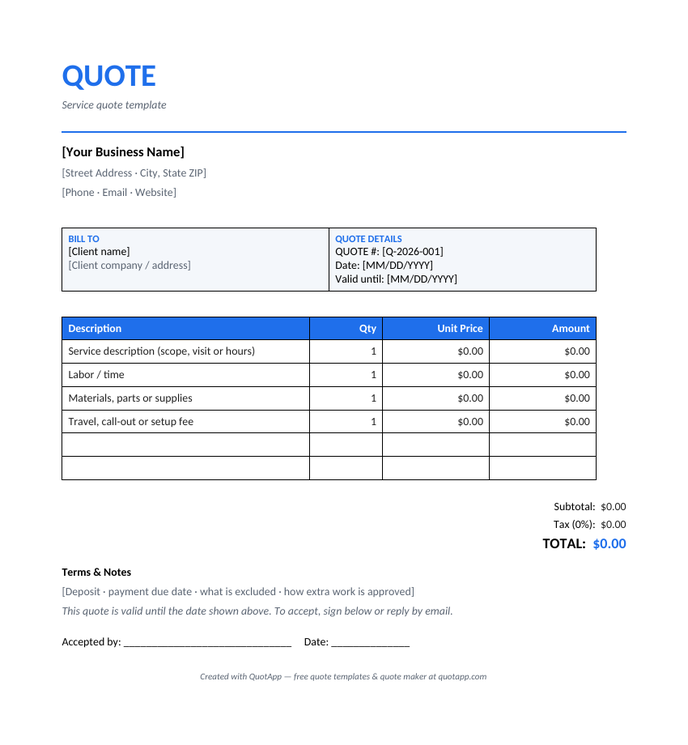
⬇ Free download — no sign-up
- Service Quote Template (Word) — Pre-filled with industry line items
- Quote Template (Excel, auto-calculating)
- Quote Template (PDF)
Create this quote online — free Browse all templates
Which service quote template do you need?
| Variant | Use it when | What changes in the template |
|---|---|---|
| One-time project (fixed fee) | A defined job with a clear end — a setup, an installation, a repair, an event, a deliverable. | Scope as a numbered list of deliverables; one fixed price or a price per deliverable; what is excluded; deposit and balance on completion. |
| Time and materials (hourly) | Diagnostics, troubleshooting or work where the effort cannot be known in advance. | Hourly or daily rate, minimum charge, estimated hours as a range, materials at cost plus markup, and a not-to-exceed figure the client approves. |
| Recurring service agreement | Monthly or weekly services — maintenance, support, bookkeeping, cleaning, lawn care, marketing retainers. | Price per period, what each period includes, response times, term and notice period, how extra work outside the plan is billed. |
| Tiered packages (good, better, best) | Clients who compare offers and need help choosing a level of service. | Two or three packages side by side, each with its inclusions; the middle option is the one you expect most clients to pick; add-ons listed once below. |
Filled-out service quote example
This is what the template looks like completed for a real job — one-time office technology setup plus the first month of a managed support plan. Prices are illustrative US figures; swap in your own rates.
Prepared for Coastal Realty Partners, 12-person office, 400 Harbor Blvd, Suite 210
| Description | Qty | Unit | Unit price | Amount |
|---|---|---|---|---|
| Network assessment and setup — firewall configuration, VLANs, guest Wi-Fi, documentation | 1 | project | $1,450.00 | $1,450.00 |
| Laptop setup and data migration — security baseline, apps, user profile | 12 | device | $95.00 | $1,140.00 |
| Business-grade Wi-Fi access point, supplied and mounted | 2 | unit | $210.00 | $420.00 |
| Microsoft 365 migration — mailboxes, calendars, shared drives | 12 | user | $45.00 | $540.00 |
| Managed support plan — first month (help desk, patching, monitoring, backups) | 12 | user | $65.00 | $780.00 |
| On-site visit and travel | 1 | visit | $75.00 | $75.00 |
Fixed prices for the setup lines; the support plan renews monthly at $65 per user and can be cancelled with 30 days' notice. Hardware (access points) supplied by us at list price; laptops supplied by the client. Migration covers email, calendars and up to 50 GB of files per user; larger mailboxes billed at $95/hour, approved in writing first. Excludes printer replacement, phone system and after-hours work. 40% deposit to schedule; balance on completion of setup. Sales tax on hardware added at invoicing where applicable. Quote valid 30 days.
Rebuild this example in the free quote generator and export it as a PDF in under a minute.
What makes a service quote different
A product quote is mostly arithmetic: item, quantity, unit price. A service quote is mostly scope. The client cannot see what they are buying until it is done, so the quote has to describe it precisely enough that both sides agree on what “finished” means. Most service disputes trace back to a line like “IT setup” or “consulting – 10 hours” that each side read differently.
Three things carry the weight in a service quote:
- Deliverables, not activities. “Firewall configured, guest Wi-Fi isolated, network documented” is checkable. “Network work” is not.
- The pricing method, stated plainly. Fixed fee, hourly with a cap, or per month — and what triggers extra charges.
- Exclusions. What you will not do is as important as what you will. In the example above, printers, phones and after-hours work are excluded and the migration has a data limit.
How to price a service
1. Know your cost per billable hour. Add your target pay (or your staff’s wages with payroll costs), your yearly overhead — software, insurance, vehicle, rent, phone, marketing — and divide by the hours you can actually bill, not the hours you work. Most service businesses bill 55–70% of working time. The hourly rate calculator and the labor cost calculator do this arithmetic.
2. Add margin. Your rate covers cost; profit is on top. A business priced at cost survives only until the first slow month.
3. Convert hours into fixed prices where you can. If a laptop setup takes you about 70 minutes, price it per device with a buffer for the one that misbehaves. Clients prefer a number they can approve; you keep the gain when you get faster.
4. Package recurring work by outcome. “Help desk, patching, monitoring and backups for $65 per user per month” sells better than “up to 4 hours of support”. Put the boundaries in writing: what is included, response time, and the rate for anything outside the plan.
5. Consider value. When the result is worth far more to the client than your time — a system that stops downtime, a campaign that fills a calendar — price closer to the value. See value-based pricing for how to do it without guessing.
6. Price materials with a markup. Parts and hardware you buy carry sourcing time, returns and warranty risk. The markup calculator turns the margin you want into the markup to apply.
What to include in a service quote
- Business name, contact details, license or registration number where your trade requires one.
- Client name, company and service address.
- Quote number, date and validity.
- Scope of work as numbered deliverables or tasks.
- Price per line, subtotal, tax where it applies, total.
- Inclusions and exclusions.
- Schedule, start date or response times.
- Who supplies materials or equipment.
- Payment terms: deposit, milestones or monthly billing.
- How extra work is approved and billed.
- For recurring services: term, renewal and notice period.
- Acceptance: signature or written approval by email.
One-time, hourly, recurring and packaged quotes
One-time projects — the example above — work best as fixed prices per deliverable. A client can see what each part costs and approve the whole or drop a line.
Hourly quotes suit work you cannot scope: troubleshooting, emergency repairs, research. Quote the rate, the minimum, an estimated range and a not-to-exceed amount. Without a cap, the client hears a running meter and argues the invoice.
Recurring services need the period price, what each period includes, the term and how either side can end it. Thirty days’ notice is common for small-business services.
Tiered packages help clients choose. Show two or three levels with clear differences, put the option you recommend in the middle, and list add-ons once. This usually raises the average order more than discounting does.
Scope, exclusions and changes
Write the scope so a stranger could check it. Then add the exclusions you would otherwise end up doing for free. Finally, say how changes work: “Work outside this scope is quoted in writing before it starts.” When the client asks for more halfway through, you send a short written addition — a change order — instead of absorbing it.
Common service quote mistakes
- Vague scope. “Consulting” or “maintenance” invites a disagreement about what was promised.
- Hourly with no cap. The client cannot budget and you get pushback at invoice time.
- Pricing at cost. Rates that cover only wages leave nothing for overhead, slow months or growth.
- No exclusions. Every unwritten boundary becomes free work.
- No validity date. A six-month-old quote resurfaces after your costs went up.
- Recurring plans with no notice period. Cancellation without notice leaves you with staff and no revenue.
Quote or proposal?
A quote is enough when the client already knows what they want and is comparing prices. When the client needs to be persuaded — a larger engagement, several competitors, a decision committee — wrap the quote in a proposal that explains the problem, your approach and why you. The difference is covered in quote vs proposal.
Sending and following up
Send the quote as a PDF the same day, with the total and the next step in the email body. If you hear nothing in two to three business days, follow up with one useful line — a start date you can hold, or an answer to a question they are likely to have. The follow-up guide has timing and wording. When the client accepts, the same lines become your invoice; see how to turn a quote into an invoice.
Frequently asked questions
What is a service quote?
A service quote is a written price for work you will perform — repairs, installation, consulting, cleaning, IT support, events — sent before the work starts. It describes the scope, the pricing method (fixed, hourly or recurring), inclusions and exclusions, timing and payment terms. Once the client accepts it, it becomes the basis of the agreement.
What should a service quote include?
Your business details, the client's details, a quote number and date, a scope of work written as deliverables or tasks, the price per line and the total, what is included and excluded, the schedule or response time, payment terms and deposit, how extra work is approved, the validity period, and an acceptance line.
How do I price a service?
Start from your true hourly cost — wages or your own target pay, plus overhead spread over the hours you can actually bill — then add your margin. Price defined jobs as a fixed fee based on the hours you expect plus a buffer, use hourly rates only for open-ended work, and package recurring services by what the client gets each month rather than by hours.
Should a service quote be fixed price or hourly?
Fixed price when you can define the scope and have done the work before; clients approve a number faster and you keep the upside of working efficiently. Hourly when the work cannot be scoped — diagnostics, emergency repairs, research — but always with an estimated range or a not-to-exceed amount.
How long should a service quote be valid?
Thirty days is the common default. Use 14 days if your costs or availability change quickly, and say that the start date is confirmed only when the quote is accepted and the deposit is paid.
What is the difference between a service quote and a service agreement?
The quote is the price and scope the client accepts. A service agreement is the longer contract for ongoing work — term, renewal, liability, confidentiality, termination. Small recurring services often run on an accepted quote with terms attached; larger ones attach the quote to a signed agreement.
Related tools and templates
- Free quote generator — build this quote online
- Hourly rate calculator — find your break-even rate
- Labor cost calculator — true cost per hour of an employee
- Value-based pricing — price the outcome, not the hours
- Quote vs proposal — when a service needs a proposal
More quote templates
Skip the template. Build it online.
The free QuotApp quote maker fills in the math, formats everything professionally, and gives you a ready-to-send PDF in under a minute.
Create a free quote now