Sales Quote Template (Price Quote)
By QuotApp Team · Updated November 13, 2026
A sales quote template — also called a price quote or quotation — is the document a seller sends a buyer before an order: products with SKUs and quantities, unit prices, discounts, shipping, taxes, lead time, payment terms and how long the prices hold. Download the free Word template below, copy the filled-out B2B example, or build the quote online with the free quote generator.
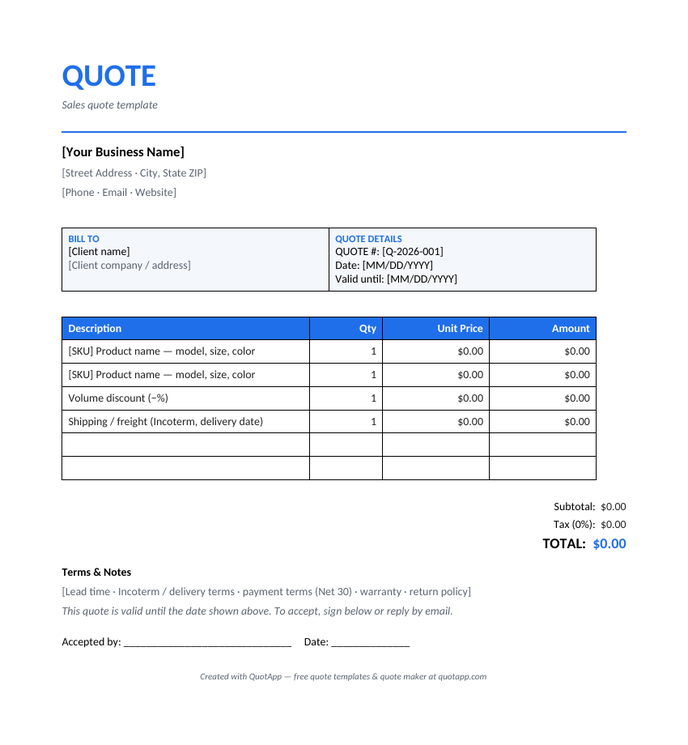
⬇ Free download — no sign-up
- Sales Quote Template (Word) — Pre-filled with industry line items
- Quote Template (Excel, auto-calculating)
- Quote Template (PDF)
Create this quote online — free Browse all templates
Which sales quote template do you need?
| Variant | Use it when | What changes in the template |
|---|---|---|
| B2B product quote | Wholesale, distribution, equipment and supplies sold to businesses. | SKU and model per line, volume discount, freight terms and Incoterm, lead time, Net 30 payment terms, PO number required to order. |
| Simple price quote | A retail or walk-in customer asks "how much for these?" and wants it in writing. | Short item list, unit and total price, tax, validity of 7–14 days, pickup or delivery note. |
| Quote with options or tiers | The buyer is choosing between models, quantities or service levels. | Base configuration priced in full; alternatives and add-ons listed as OPTION lines; the total reflects the base only. |
| Formal quotation (RFQ response) | Responding to a buyer's request for quotation with a fixed line list. | Line numbers match the RFQ; quantities and specs exactly as requested; deviations listed separately; compliance statements and validity as required. |
| Subscription or SaaS quote | Software, memberships or any recurring product. | Plan, seats and billing period; one-time fees separate from recurring; term, renewal and price-increase clause; order form signature. |
Filled-out sales quote example
This is what the template looks like completed for a real job — equipment quote for two café openings — espresso machines, grinders, filtration, freight and on-site training. Prices are illustrative US figures; swap in your own rates.
Prepared for Harbor Café Group — purchasing, 2 new locations
| Description | Qty | Unit | Unit price | Amount |
|---|---|---|---|---|
| [ESP-2G] Commercial espresso machine, 2-group, volumetric | 2 | unit | $6,450.00 | $12,900.00 |
| [GR-64] On-demand espresso grinder, 64 mm flat burrs | 2 | unit | $1,180.00 | $2,360.00 |
| [WF-10] Inline water filtration and scale-inhibitor kit | 2 | kit | $285.00 | $570.00 |
| Volume discount — 5% on equipment lines | 1 | line | −$791.50 | −$791.50 |
| Freight — LTL with liftgate delivery, 2 locations | 1 | shipment | $340.00 | $340.00 |
| Installation and barista training on site (4 h) | 2 | site | $450.00 | $900.00 |
Prices in USD, valid 21 days. 5% volume discount applies to equipment lines when both locations order together. Freight LTL with liftgate, FOB origin, delivered within 3–4 weeks of PO. Installation and barista training on delivery week, 4 hours per site. Manufacturer warranty 2 years parts / 1 year labor. Payment Net 30 with approved credit; otherwise 50% with PO, balance before shipment. Sales tax calculated at invoicing based on ship-to address; resale or exemption certificate required to waive. Order by PO referencing this quote number.
Rebuild this example in the free quote generator and export it as a PDF in under a minute.
Sales quote, price quote, quotation: one document
Buyers and sellers use the three names for the same thing. What matters is that the document lets the buyer do two jobs: get the purchase approved inside their company, and place an order that matches what you priced. Everything on a good sales quote serves one of those two jobs.
For approval, the buyer needs a clear total, what is included, lead time and terms they can show a manager. For ordering, they need a quote number, exact SKUs and quantities, and instructions — usually “issue a PO referencing this quote.”
What to include in a sales quote
- Seller details — company, address, sales contact, tax ID where your country uses one on commercial documents.
- Buyer details — company, contact, bill-to and ship-to addresses if different.
- Quote number, date and validity — for example Q-2026-0145, valid 21 days.
- Line items — SKU or model, description specific enough to avoid substitution, quantity, unit, unit price, line total.
- Discounts — as their own line with the condition attached.
- Freight and delivery — method, who pays, Incoterm for international orders (EXW, FOB, DAP…), estimated lead time.
- Taxes — how sales tax or VAT is handled and what exemption paperwork is required.
- Payment terms — Net 30, deposit with order, card, wire; late payment terms if you use them.
- Warranty and returns — manufacturer warranty, restocking fees, return window.
- How to order — PO, signature or online acceptance.
How to price a sales quote
Start from landed cost. Product cost plus inbound freight, duties and handling is what the item really costs you. Quote from there, not from the supplier’s invoice line.
Apply a margin you choose on purpose. Markup and margin are not the same: a 40% markup is only a 28.6% margin. The markup calculator converts the margin you need into the markup to apply.
Use discounts as levers, not concessions. Tie every discount to something the buyer gives back — volume, a combined order, faster payment, a longer contract. “5% when both locations order together” in the example is a reason; “5% off” is just a lower price.
Price freight honestly. Absorbing freight on small orders is how distributors lose money without noticing. Quote it as a line or set a free-freight threshold.
Show options separately. Upgrades and alternatives go below the base as OPTION lines, so the headline total stays comparable with competitors.
Lead time, Incoterms and payment terms
Lead time is often the deciding factor for a B2B buyer. State it as a range from PO date (“3–4 weeks from PO”), not as a promise of a calendar date you do not control.
For international sales, name the Incoterm and the place: “FOB Port of Savannah” or “DAP buyer’s warehouse, Monterrey”. The Incoterm decides who pays freight and insurance and where the risk passes; leaving it out is the most common cause of cross-border disputes on small orders.
Payment terms should say what happens without approved credit. The example offers Net 30 to approved accounts and a deposit-with-PO alternative for everyone else.
Quotes with options and RFQ responses
When you answer a buyer’s request for quotation, mirror their format: same line numbers, same quantities, same units. List any deviation — a substitute model, a different pack size — in a separate section. Buyers compare RFQ responses line by line, and a quote that does not line up is set aside.
When you are selling, not responding, options help the buyer move up. Price the configuration you recommend as the base and list the step up and step down as options.
From quote to order to invoice
Once the buyer accepts, everything downstream should reference the quote number: the PO, your order confirmation, the packing slip and the invoice. Copying the same lines forward avoids re-keying errors and makes reconciliation trivial for the buyer’s accounts payable team. The process is laid out step by step in how to convert a quote to an invoice.
Common sales quote mistakes
- No SKU or model. The buyer orders “the same as last time” and receives something else.
- Free freight by default. Margin disappears on small orders.
- Discount hidden in the unit price. The next quote starts from the discounted price.
- No validity date. Prices are held long after your supplier raised theirs.
- Missing tax treatment. The invoice total surprises the buyer and payment stalls.
- Lead time omitted. The buyer assumes stock and escalates when the order is three weeks out.
Sending the quote and following up
Send a PDF — not an editable file — and put the total, the validity date and the next step in the email body. Buyers forward quotes to approvers who will not open attachments. Follow up before the quote expires with something useful, such as confirmed stock or an updated lead time; the follow-up guide has examples. For quotes you build often, the Excel quote template calculates totals automatically, and the free quote generator produces a PDF in a minute.
Frequently asked questions
What is a sales quote?
A sales quote is a document a seller sends a prospective buyer listing the products or services, quantities, prices, discounts, shipping, taxes and terms for a proposed sale. It lets the buyer approve the purchase internally and, once accepted or matched by a purchase order, becomes the basis of the order.
Is a price quote the same as a sales quote or a quotation?
In practice, yes. Price quote, sales quote and quotation are used interchangeably for the same document. Some companies reserve 'quotation' for formal responses to a buyer's RFQ, and 'price quote' for quick written prices, but the contents are the same.
What should a sales quote include?
Seller and buyer details, quote number and date, line items with SKU or model, description, quantity, unit and unit price, discounts, subtotal, shipping and freight terms, taxes, total, lead time, payment terms, warranty, validity period and how to order — usually a purchase order referencing the quote number.
Is a sales quote legally binding?
A quote is generally an offer: when the buyer accepts it within the validity period — by signing or issuing a matching purchase order — a contract can form on those terms. Rules vary by country and by your terms of sale, which is why the validity period and the terms should be on the quote itself.
How long should a price quote be valid?
Long enough for the buyer to get approval, short enough to protect you from cost changes. Fourteen to thirty days is common; 7 days for volatile prices such as metals, fuel-sensitive freight or currency-exposed imports.
How do I show discounts on a quote?
As a separate negative line or a discount column, never by quietly lowering the unit price. A visible discount shows the buyer what they saved, ties it to a condition (volume, both locations, payment terms) and keeps your list prices intact for the next quote.
What is the difference between a sales quote and a pro forma invoice?
A sales quote proposes a price before the buyer commits. A pro forma invoice is issued after the buyer agrees, in invoice format, so they can arrange payment, import permits or a letter of credit before the goods ship. Neither is a request for payment like a final invoice.
Related tools and templates
- Free quote generator — build this quote online
- Markup calculator — price products from cost
- What is an RFQ — answering a request for quotation
- Quote template for Excel — automatic totals
- How to turn an accepted quote into an invoice
More quote templates
Skip the template. Build it online.
The free QuotApp quote maker fills in the math, formats everything professionally, and gives you a ready-to-send PDF in under a minute.
Create a free quote now