Bid Proposal Template
By QuotApp Team · Updated November 13, 2026
A bid proposal template is the document a contractor submits to win a project: a bid form with the base bid, alternates and unit prices, the scope you are pricing, exclusions and clarifications, schedule, qualifications, bonds and how long the price holds. Download the free Word bid proposal and bid form below, copy the filled-out commercial example, and price the line items with the free quote generator.
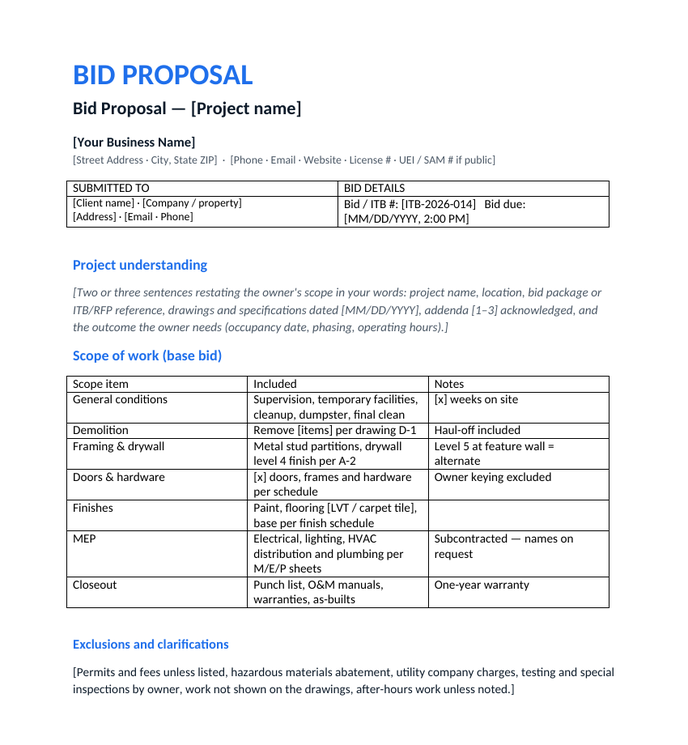
⬇ Free download — no sign-up
- Bid Proposal Template (Word) — Cover, scope, pricing, terms and acceptance page
- Bid Form / Pricing Schedule (Word) — Line-item pricing behind the base bid
- Quote Template (Excel, auto-calculating)
Create this quote online — free Browse all templates
Which bid proposal template do you need?
| Variant | Use it when | What changes in the template |
|---|---|---|
| Private commercial bid | An owner, developer or general contractor invites a few contractors to price a defined scope. | Scope by trade or division; exclusions and clarifications; alternates; schedule; insurance; payment terms with retainage; validity 30–60 days. |
| Public bid (ITB / sealed bid) | Government, school districts, municipalities — usually lowest responsive, responsible bidder. | The owner's bid form filled in exactly as issued; bid bond; addenda acknowledged; required affidavits and forms; no added conditions — qualifications can make a bid non-responsive. |
| Subcontractor bid to a GC | A trade contractor prices its scope for a general contractor's bid. | Scope tied to specification sections and drawing sheets; inclusions and exclusions per trade; unit prices; validity tied to the GC's award; bonding capacity. |
| Residential bid | A homeowner collects bids for a remodel, addition or new build. | Plain-language scope by room or phase; allowances for finishes; exclusions; payment schedule by milestone; warranty; fewer formal attachments. |
Filled-out bid proposal example
This is what the template looks like completed for a real job — bid form for an office tenant improvement — demolition, partitions, doors, finishes, MEP and general conditions. Prices are illustrative US figures; swap in your own rates.
Prepared for Riverside Insurance Agency — ITB
| Description | Qty | Unit | Unit price | Amount |
|---|---|---|---|---|
| General conditions — superintendent, temporary facilities, dumpsters, cleanup | 6 | week | $2,850.00 | $17,100.00 |
| Selective demolition and haul-off per D-1 | 1 | lot | $6,800.00 | $6,800.00 |
| Metal stud and drywall partitions, level 4 finish | 3600 | sq ft | $7.25 | $26,100.00 |
| Doors, frames and hardware per door schedule | 14 | opening | $1,350.00 | $18,900.00 |
| Flooring — LVT and carpet tile, rubber base | 4800 | sq ft | $6.10 | $29,280.00 |
| Painting — walls, frames, accent colors | 1 | lot | $9,450.00 | $9,450.00 |
| Mechanical, electrical and plumbing — subcontract | 1 | lot | $88,500.00 | $88,500.00 |
| Builder's risk insurance and bonds | 1 | lot | $3,950.00 | $3,950.00 |
| Overhead and profit — 10% of cost | 1 | lot | $20,008.00 | $20,008.00 |
Base bid per drawings A-1 to A-6 and M/E/P sheets dated 09/30/2026, addenda 1 and 2 acknowledged. Alternate 1 (level 5 finish at reception feature wall): add $2,150. Alternate 2 (owner-furnished carpet tile in lieu of supplied): deduct $11,400. Unit price: additional partition wall $7.25 per sq ft. Excludes permits and plan-review fees, hazardous materials abatement, data cabling, furniture and after-hours work. Bid valid 60 days. Substantial completion 6 weeks after notice to proceed. Monthly progress billing, 5% retainage. Bid bond 5% attached.
Rebuild this example in the free quote generator and export it as a PDF in under a minute.
What is in the bid proposal template
The download contains two files that work together:
- Bid proposal (Word) — cover with project and bid reference, project understanding, scope of the base bid by trade, exclusions and clarifications, qualifications and schedule, bid price summary with alternates and unit prices, terms (validity, payment, retainage, bonds), acceptance, and an attachments checklist for the documents owners usually require.
- Bid form / pricing schedule (Word) — the itemized line-item pricing behind the base bid, built like a quote: scope item, labor, materials, general conditions, bond and insurance, with totals.
If the owner issues its own bid form, use theirs and attach these pages only where the instructions allow it. On public bids, an extra page with conditions can make the bid non-responsive.
How to put a bid together
1. Read the bid documents twice. Instructions to bidders, bid form, drawings, specifications, addenda and the contract form. Most losing bids, and most money-losing jobs, start with a missed addendum or a specification section nobody priced.
2. Do the takeoff by division or trade. Quantities from the drawings — square feet of partitions, door openings, square feet of flooring, fixtures, devices. Use the same units the owner uses for unit prices.
3. Price direct costs. Labor from your crews’ production rates, materials from current supplier pricing, equipment, and subcontractor quotes for the trades you do not self-perform. Get at least two sub quotes per major trade and level them line by line: same scope, same exclusions.
4. Add general conditions. Supervision, temporary facilities, dumpsters, cleanup, permits if included, small tools — priced per week of the schedule.
5. Add bonds, insurance, overhead and profit. Bond and builder’s risk as quoted by your broker. Overhead and profit from your own numbers. The markup calculator converts a target margin into the markup to apply, which avoids the classic mistake of adding 10% and 10% and calling it 20% margin.
6. Price alternates and unit prices. Each alternate as an add or deduct from the base bid, with its own scope sentence. Unit prices for the items most likely to change in quantity.
7. Write exclusions and clarifications. Short, specific, tied to sheet numbers or spec sections. Long lists of boilerplate exclusions read as a contractor protecting itself from the job.
8. Check the total from the top down. Cost per square foot against your recent similar jobs. In the example, the base bid is $220,088 for 4,800 sq ft, about $46 per sq ft for a light office build-out — in line with the contractor’s own history for similar work.
Bid, quote or proposal?
A bid is a response to an owner’s invitation to price a defined scope, often against competitors and often on the owner’s form. A quote is a price you offer, usually without a formal invitation. A proposal is a persuasive document that explains approach and value. Owners send an invitation to bid (ITB) when the scope is fixed, and a request for proposal when they want to compare approaches — see RFQ vs RFP. The bid proposal template sits between them: a competitive price with just enough proposal to show you understood the job.
Public vs private bids
Public bids follow procurement rules: sealed submission by a deadline, the owner’s bid form filled in exactly, a bid bond, addenda acknowledged, required affidavits and certifications. The award usually goes to the lowest responsive and responsible bidder. Do not add conditions, change quantities or attach your own terms unless the instructions allow it.
Private bids are more flexible. Owners and general contractors read the clarifications, compare exclusions and often interview the two or three lowest bidders. Here, completeness and clarity win jobs that are not the cheapest.
Subcontractor bids to a general contractor
Trade contractors bidding to a GC should tie every inclusion to specification sections and drawing sheets, list exclusions per trade, give unit prices, and state that the bid is valid until the GC’s award plus a set number of days. Send it early: GCs level sub bids in the hours before the deadline and a late number is often left out.
Common bid proposal mistakes
- Missed addenda. An unacknowledged addendum can disqualify a public bid and leaves scope unpriced on a private one.
- Unleveled sub quotes. The cheapest sub price often excludes what the others included.
- Overhead guessed, not calculated. Use last year’s real overhead as a share of revenue.
- Boilerplate exclusions. Fifty generic exclusions signal risk; ten specific ones signal understanding.
- No unit prices for quantities that change. Every extra square foot becomes a negotiation.
- Unsigned or wrong signatory. The bid must be signed by someone authorized to bind the company.
- Late submission. Public deadlines are absolute.
After the bid
If you are the apparent low bidder on a private job, expect a scope review meeting: bring the takeoff and the sub leveling. Once awarded, the bid lines become the schedule of values for progress billing, and any later change is priced as a change order. If the owner prefers open-book pricing, see cost-plus pricing. For smaller jobs priced without a formal invitation, the construction quote template is the faster format.
Frequently asked questions
What is a bid proposal?
A bid proposal is a contractor's formal offer to perform a defined scope of work for a stated price. It includes the bid form with the base bid and any alternates or unit prices, the scope and exclusions, the schedule, qualifications, required bonds and insurance, and the validity period. If the owner accepts it, it becomes the basis of the construction contract.
What is the difference between a bid, a quote and a proposal?
A bid answers an owner's invitation to price a defined scope, usually in competition and often on the owner's form. A quote is a price you offer for work or products, often without a formal invitation. A proposal adds the case for choosing you — approach, team, schedule, value. A bid proposal combines the competitive price with enough of the proposal to show you understood the job.
What should a bid proposal include?
Your company and license details, the project and bid reference, the base bid, alternates and unit prices, the scope by division or trade, exclusions and clarifications, addenda acknowledged, schedule and duration, key personnel and similar projects, safety record, insurance and bonding, payment terms and retainage, validity period, signature of an authorized officer, and any forms the owner requires.
How do I calculate overhead and profit on a bid?
Price direct costs first — labor, materials, equipment, subcontracts and project general conditions. Then add company overhead (office, estimators, insurance, vehicles) as a percentage based on last year's overhead divided by revenue, and profit on top. Many commercial bids land between 10% and 20% combined, but use your own numbers: a bid at someone else's markup can win and still lose money.
What is a bid bond?
A guarantee, usually 5% to 10% of the bid amount, from a surety that you will sign the contract and provide performance and payment bonds if awarded. Public projects and many private ones require it. You need an established relationship with a surety before bid day; it cannot be arranged in an afternoon.
How long should a bid be valid?
Long enough for the owner to evaluate and award — typically 30, 60 or 90 days, often set by the bid documents. Longer validity exposes you to material price changes, so state any escalation clause or material price-hold limits in your clarifications where the documents allow it.
How do I win a bid without being the lowest price?
On public bids with low-bid award, you mostly cannot — compete on accuracy and efficiency instead. On private and negotiated bids, owners pick the bid they trust: complete scope, few exclusions, a realistic schedule, relevant references, and a clear explanation of what cheaper bids left out. Clear alternates and value-engineering options also help.
Related tools and templates
- Construction quote template — line-item pricing
- Free quote generator — price the bid form online
- RFQ vs RFP — what the owner is asking for
- Cost-plus pricing — when the owner wants open book
- Markup calculator — overhead and profit to markup
More proposal templates
Skip the template. Build it online.
The free QuotApp quote maker fills in the math, formats everything professionally, and gives you a ready-to-send PDF in under a minute.
Create a free quote now